Synthetic Data: What It Is and Why It Matters
From turbocharging AI development to protecting sensitive information, synthetic data is revolutionizing the way we train machines and share insights. But beneath its promise lies a complex web of risks - from bias amplification to privacy leakage - that must be carefully managed.
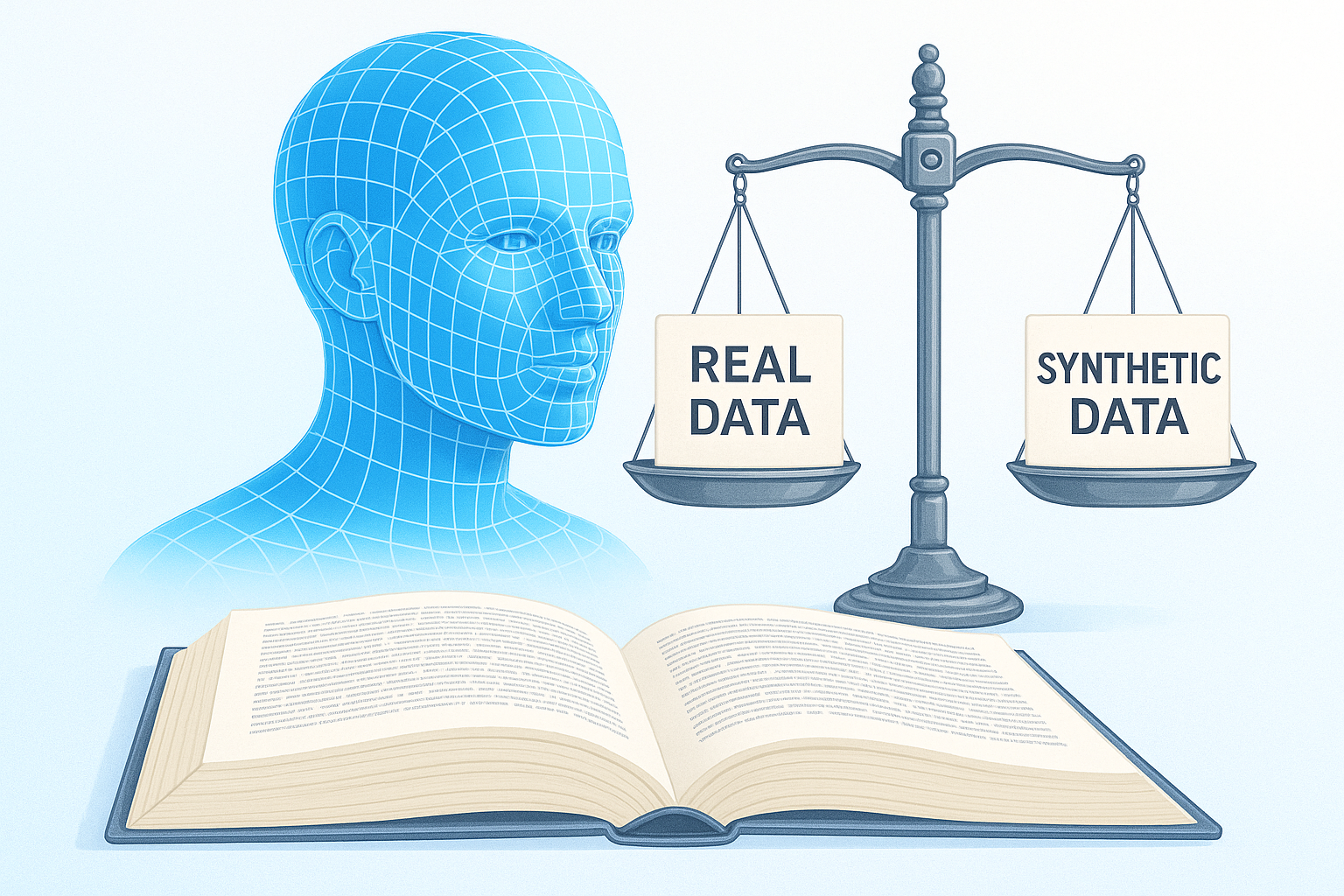
What is Synthetic Data?
Synthetic data is artificial data generated by algorithms to mimic real-world data patterns . In practice, computers generate synthetic records or images that have the same statistical properties (like means, variances, and correlations) as real data but contain no actual private information. This can include fully synthetic datasets (entirely invented) or partially synthetic data (where sensitive fields are replaced with artificial values). By design, synthetic data “looks like” real data and is used in place of it for testing, developing, or training machine learning models. For example, synthetic tables can stand in for a production database, or synthetic images can simulate real photographs, thereby allowing data scientists to experiment without using sensitive real data.
How does it Work?
Synthetic data generation relies on statistical or AI-based models that learn from real datasets. Simple methods draw values from the same distributions or use interpolation to create new points. More advanced techniques use generative models: for instance, generative adversarial networks (GANs) pit two neural nets against each other (one creates fakes, the other tries to detect them) to produce realistic samples. Variational Autoencoders (VAEs) and modern transformer models (like GPT for text) can also generate synthetic images, text, or tabular records after being trained on real examples. Agent-based simulations can create synthetic data by simulating individuals or events according to specified rules (for example, simulating people moving during an epidemic). In all cases, the goal is to capture the complex patterns of the original data.
benefits of Synthetic Data
Synthetic data can unlock new opportunities for AI and analytics. Key advantages include:
- Privacy and Compliance: Synthetic data can preserve individual privacy because it contains no real personal records. When generated correctly, no synthetic record can be traced back to a real person, acting like a form of strong anonymization. This helps organizations share and analyze data without exposing sensitive information. For example, a hospital could use partially synthetic medical records to develop a diagnostic AI model without risking patient privacy.
- Augmenting Rare Scenarios: It can fill gaps where data is scarce. A company can generate unusual or rare events to train models better. For instance, a bank might lack many examples of credit-card fraud. By creating fully synthetic transactions (including made-up fraud cases), it can train fraud-detection algorithms more effectively. This boosts model performance on edge cases.
- Increased Efficiency: Generating synthetic data is often much faster and cheaper than collecting real data. Teams don’t need to wait weeks or months to gather new data – they can produce large datasets on demand. Also, synthetic data often comes pre-labeled (since the generator “knows” the ground truth), saving time on manual annotation. This accelerates development and testing of machine learning models.
- Greater Control and Diversity: Synthetic generation lets data scientists tailor datasets to their needs. They can create balanced or enlarged datasets that cover more scenarios than the original data. For example, under-represented groups or rare conditions can be upsampled synthetically, improving fairness and robustness. Synthetic data can simulate outliers and extreme events to make models more resilient to variability.
Since synthetic data contains no real PII, it can be shared freely between teams and organizations. Researchers or developers can work with realistic data in a secure way, without confidentiality barriers.
Risks and Limitations
While synthetic data is powerful, it is not a panacea. Important risks include:
- Limited Realism: Synthetic data may fail to capture the full complexity of real data. Models generating synthetic data can miss subtle patterns or anomalies. For example, a generated dataset might replicate average behavior well but omit rare outliers or intricate correlations. If the synthetic data lack critical details, an AI model trained on them may perform poorly on real-world inputs. In short, “ground truth” is missing: the synthetic data only approximates reality.
- Bias Propagation: Any biases in the original training data can be carried over (or even amplified) in synthetic data. Since the generator learns from real data, it may replicate imbalances (e.g. under-representing certain groups). This means that without careful oversight, synthetic data can entrench unfairness in AI models.
- Privacy Leakage: Synthetic data is not automatically free of privacy concerns. If not carefully managed, a synthetic dataset can leak information about real individuals. For example, if a generative model overfits or memorizes its input data, it might inadvertently reproduce actual sensitive records. As one report notes, “synthetic data has the capacity to leak information about the data it was derived from”. In fact, guaranteeing privacy often requires extra measures (like differential privacy) during generation.
- Model Collapse (Overfitting to Fakes): A recent study found that training AI models on data that came from other AIs can cause a “model collapse” over time. This means the models progressively lose touch with reality, producing nonsensical outputs. In practice, this suggests synthetic data should supplement real data, not replace it entirely, to avoid drifting into unrealistic patterns.
- Quality Verification: It can be hard to check how “good” synthetic data really is. Without real benchmarks, validating synthetic data’s accuracy and reliability is challenging. Additional testing is needed to ensure the generated data match key statistics of the target domain.
- Trade-Offs (Accuracy vs. Privacy): There is often a trade-off between utility and privacy. Making synthetic data very privacy-preserving (by heavily distorting it) can reduce its realism and accuracy. Finding the right balance for a given application is nontrivial. For instance, hiding outliers or rare cases is sometimes necessary for privacy, but this can remove exactly the signals a model needs to learn.
Given these risks, experts caution that synthetic data should be used carefully. It is generally viewed as a tool to augment real data, rather than a full replacement. When applied thoughtfully, synthetic data can protect privacy and enrich datasets, but it requires validation and safeguards to avoid undermining its benefits.
Conclusion
Synthetic data is quickly becoming a cornerstone of the digital world. From training smarter AI systems to enabling safer data sharing, it offers a powerful way to unlock insights without compromising privacy. Its flexibility, speed, and ability to simulate rare or sensitive scenarios make it an attractive option for businesses, governments, and developers alike. With synthetic data, we can build and test technology in a more secure and inclusive way – without waiting for or exposing real-world data.
But synthetic data isn’t a silver bullet. Like any tool, it comes with risks. If not handled responsibly, it can introduce errors, reinforce bias, or even blur the line between what’s real and what’s artificial. As we move toward a future where synthetic data becomes more common than real data, it’s important to stay grounded in transparency, ethics, and oversight. The goal shouldn’t be to replace reality, but to extend it – safely and smartly.
Knowledge - Certification - Community