
Course Summary
The Artificial Intelligence Fundamentals (AIFU®) Certification, developed under the DASCIN® Enterprise Big Data Framework, offers a structured and comprehensive foundation in Artificial Intelligence (AI). While the AI Awareness programme focus on recognising AI’s basic principles and immediate business implications, this certification goes further by exploring conceptual, technological, and enterprise implementation aspects of AI including governance, ethical risks, and implementation strategies without requiring any coding or technical background.
Throughout the course, participants explore key AI domains, including the distinctions between weak, strong, and general AI, machine learning and deep learning architectures (CNNs, RNNs, GANs), Natural Language Processing (NLP), and Computer Vision. Additionally, the course covers large language models (LLMs), transformer architectures, prompt engineering, training approaches such as pre-training, fine-tuning, and RLHF, and learning strategies including zero-shot, one-shot, and few-shot learning. Participants also examine multimodal AI concepts, principles of responsible AI, and strategies for enterprise adoption.
By combining conceptual explanations with real-world examples and case studies, participants gain the knowledge to differentiate AI technologies, evaluate their capabilities and limitations, and assess AI solutions across industries such as healthcare, finance, and logistics.
At the end of the course, participants can apply foundational AI knowledge, analyse ethical and societal implications, and interpret emerging AI trends. They also learn to support value-driven implementation, governance, and responsible AI practices.
Overall, this certification provides a practical and strategic foundation for contributing to, evaluating, and championing AI adoption in modern organisations.
detailed course Information
The Artificial Intelligence Fundamentals (AIFU®) course bridges core concepts, key technologies, and enterprise applications of AI. It is designed for professionals, business leaders, and technology practitioners who want to understand, evaluate, and support AI adoption in real-world organisational contexts without requiring any coding or technical background.
Participants will learn to:
- Introduction to AI: Learn AI’s historical evolution, core concepts, and the distinctions between weak (narrow), strong (human-level), and general AI, and assess their practical relevance in business and society, including AI’s role in automation, augmentation, and decision support.
- Key Technologies in AI: Examine Natural Language Processing (NLP), Computer Vision, and deep learning architectures including CNNs, RNNs, and GANs, and differentiate between machine learning types; supervised, unsupervised, and reinforcement learning across real-world domains such as healthcare, finance, and retail.
- Generative AI and Large Language Models: Learn transformer architectures, prompt engineering strategies, training approaches such as pre-training, fine-tuning, and RLHF, and learning strategies including zero-shot, one-shot, and few-shot learning, alongside limitations such as bias and hallucination.
- Multimodal AI: Explore the integration of text, image, and audio data, fusion strategies including early, late, and hybrid fusion, and real-world applications such as visual question answering and robotics.
- Business Applications of AI: Apply AI strategy and planning, solution design, organisational change management, ROI measurement, ethical deployment, responsible AI principles, regulatory compliance, and AI governance frameworks within enterprise contexts.
By combining conceptual explanations with real-world examples and case studies, participants gain the knowledge to differentiate AI technologies, evaluate their capabilities and limitations, and assess AI solutions effectively enabling organisations to harness AI’s transformative potential while managing risks responsibly.
The Artificial Intelligence Fundamentals (AIFU®) course provides a comprehensive and structured understanding of how Artificial Intelligence is applied in real-world enterprise settings. Designed to bridge the gap between AI awareness and business implementation, the course explores essential AI technologies and methodologies including machine learning, deep learning, generative AI, and multimodal AI, while emphasising ethical, governance-aligned, and responsible adoption in organisations.
Area 1: Introduction to AI
This area focuses on understanding the foundational principles of AI and their relevance to enterprise applications. Participants will explore AI’s historical evolution, differentiate between AI types, and assess AI’s broader role in organisations. Key topics include:
- Distinctions between weak (narrow), strong (human-level), and general AI in practical and theoretical contexts
- Machine learning types — supervised, unsupervised, and reinforcement learning — and their real-world applications
- Deep learning as a subset of machine learning, including the role of neural networks
- AI’s role in automation, augmentation, and decision support within business environments
Area 2: Key Technologies in AI
This area examines the core technologies that underpin modern AI systems. Participants will evaluate their applications, effectiveness, and limitations across industries. Key topics include:
- Natural Language Processing (NLP) techniques including tokenisation, sentiment analysis, machine translation, and named entity recognition
- Computer Vision applications such as facial recognition and object detection
- Deep learning architectures including CNNs, RNNs, GANs, and Autoencoders
- Real-world NLP applications across virtual assistants, search engines, healthcare, and legal automation
Area 3: Generative AI and Large Language Models
This area focuses on understanding LLM architectures, training processes, and their enterprise applications. Participants will explore transformer models, prompting strategies, and ethical considerations. Key topics include:
- Transformer architecture components including self-attention and positional encoding
- LLM development stages: pre-training, fine-tuning, and RLHF (Reinforcement Learning from Human Feedback)
- Zero-shot, one-shot, and few-shot learning strategies
- Prompt engineering principles and their influence on model output quality
- Emerging trends including synthetic data generation, alignment challenges, and compute trade-offs
Area 4: Multimodal AI
This area introduces multimodal AI systems and their ability to process and integrate multiple data types. Participants will evaluate fusion techniques, real-world use cases, and emerging developments. Key topics include:
- Foundational concepts of multimodal AI and how text, image, and audio data are integrated
- Fusion strategies including early, late, and hybrid fusion approaches
- Real-world applications such as caption generation, visual question answering, and robotics
- Benefits, limitations, and emerging trends including unified architectures and continual multimodal learning
Area 5: Business Applications of AI
This area equips participants to assess AI’s strategic, operational, and ethical impact in organisations. It covers frameworks and practices for integrating AI initiatives responsibly and effectively. Key topics include:
- Aligning AI initiatives with business objectives and measurable value
- AI solution design and delivery models, including build vs. buy approaches and the AI adoption lifecycle
- Managing organisational change, workforce impact, and cross-functional collaboration
- Measuring AI success through KPIs, ROI indicators, and continuous monitoring frameworks
- Ensuring ethical, secure, and trustworthy AI deployment including bias mitigation, explainability, and regulatory compliance (e.g., GDPR, CCPA)
- Applying AI governance and leadership practices including ethics committees, audits, and risk controls
The Artificial Intelligence Fundamentals (AIFU®) course is designed for professionals who have a basic awareness of AI and are looking to build a deeper and more structured understanding of its concepts, technologies, and enterprise applications. It is particularly suited for:
- Business and Technology Leaders: Executives, CIOs, CTOs, digital transformation managers, and innovation leads who need to evaluate, govern, and implement AI projects aligned with business objectives and measurable value.
- AI Project Contributors: Business analysts, product owners, and project managers who are actively involved in AI initiatives and need to understand AI system structures, lifecycle management, and ROI considerations.
- Data and IT Professionals: Individuals in technical roles looking to build broader knowledge around responsible AI implementation, governance, and organisational impact without requiring deep coding expertise.
- Policy and Compliance Officers: Government officials, advisors, and compliance professionals involved in developing or enforcing regulatory policies around AI adoption, transparency, ethics, and compliance in both private and public sectors.
- Educators and Lifelong Learners: Academics, researchers, and students who wish to go beyond AI awareness and explore practical frameworks for applying AI responsibly across industries.
This course is accessible to both technical and non-technical audiences, requiring no prior coding experience, and is ideal for anyone looking to move beyond introductory AI concepts and contribute meaningfully to AI discussions and initiatives within enterprise environments.
The AIFU® course concludes with an official examination, designed to validate the participant’s understanding of core AI concepts, technologies, and enterprise applications. This structured assessment ensures that learners have grasped the foundational knowledge required to engage with AI confidently in organisational contexts. Below are the key details about the examination:
- Material Allowed: This is a closed book exam. The AI Fundamentals Guide should be used for study purposes but is not permitted during the examination.
- Exam Duration: The exam is 60 minutes long. Candidates taking the exam in a language other than their native or working language may be awarded 25% extra time, extending the duration to 75 minutes.
- Marks and Scoring: The exam consists of 40 multiple-choice questions, each worth 1 mark. There is no negative marking, and unanswered questions will receive no marks. To pass, participants must score 26 marks (65%) or more. An elevated pass mark of 30 marks (75%) is required for individuals aspiring to become certified trainers.
- Complexity: The exam is based on Bloom’s Levels 1 and 2. Level 1 tests the recall of fundamental AI concepts such as AI types, machine learning techniques, and key technologies. Level 2 assesses understanding through tasks such as explaining NLP applications, interpreting generative AI concepts, and evaluating multimodal AI systems and enterprise AI strategies.
- Question Types: All questions are multiple-choice with four options and include classic, negative, missing word, and list-style formats to assess comprehension and conceptual understanding across all five syllabus areas.
This examination is designed to confirm that participants have achieved a solid and structured foundation in Artificial Intelligence, enabling them to differentiate AI technologies, evaluate their capabilities and limitations, and support responsible, governance-aligned AI adoption within real-world enterprise contexts.
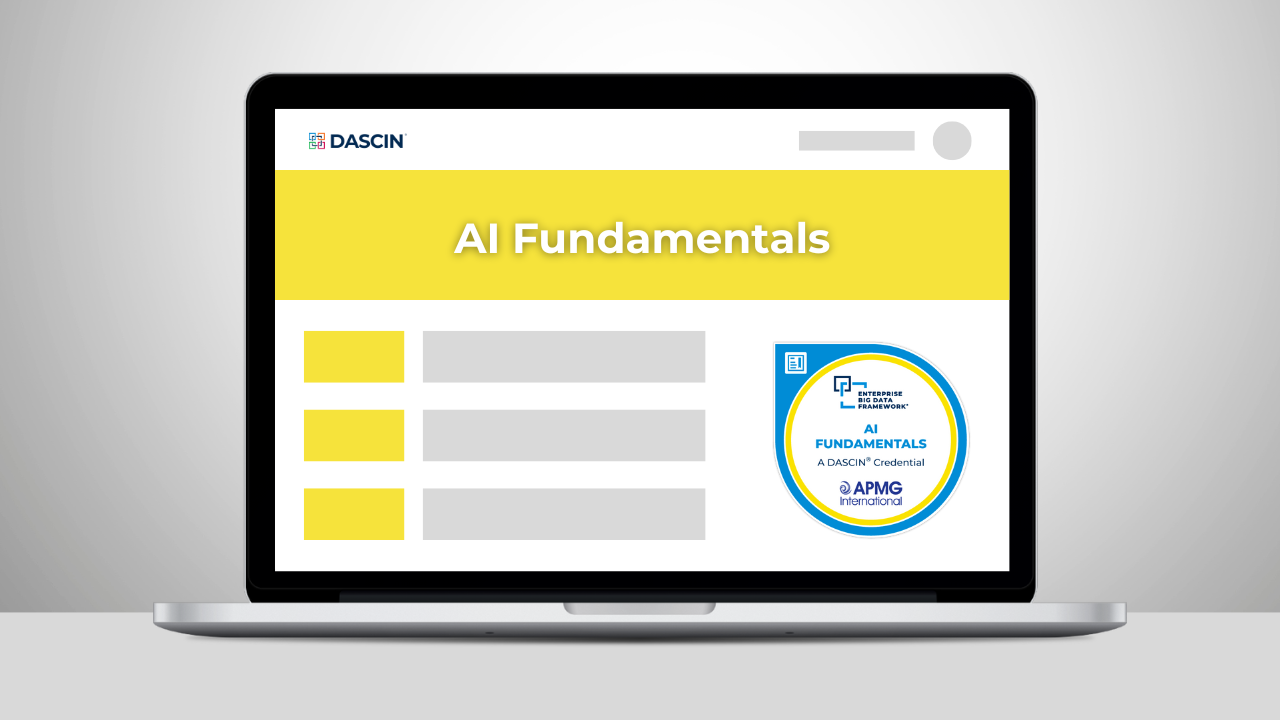
Digital Badge

Course Details



Testimonials & Course Reviews
The AI Fundamentals course was an eye-opening experience that transformed my understanding of Artificial Intelligence. What set this course apart was the depth of content on Machine Learning and Deep Learning.
The AI Fundamentals course exceeded all my expectations in terms of content quality, practical insights, and delivery. As an IT Manager responsible for integrating AI solutions into our operations, I needed a course that went beyond the basics. This program delivered precisely that. The modules were thoughtfully designed, starting with the foundational AI Concepts and gradually building up to advanced topics like Natural Language Processing and Generative AI.
The section on Enterprise Usage of AI was particularly valuable, offering detailed insights into how companies leverage AI for innovation and efficiency. The instructors used real-world examples from diverse industries, which made the material highly relatable and applicable. The inclusion of Computer Vision and its role in areas like facial recognition and autonomous vehicles was an added bonus.
The AI Fundamentals course was exactly what I needed to understand how AI is transforming industries like marketing. The concepts were explained clearly, and the real-world examples made everything relatable. I now feel confident discussing AI strategies with my team and exploring tools like Natural Language Processing and Generative AI for creative campaigns.
This course was incredible! It gave me a solid foundation in AI concepts and techniques without overwhelming me with jargon. The hands-on case studies and practical examples were engaging, and the module on AI ethics was truly thought-provoking. A great starting point for anyone curious about AI!
This course completely changed how I think about Artificial Intelligence. I don’t come from a technical background, so I was a bit nervous about diving into something as complex as AI. But the way the course was laid out made it easy to follow, even for someone like me.
I loved how practical it was—especially the modules on Machine Learning and Natural Language Processing. It wasn’t just theory; they showed real examples of how these tools are being used in industries like logistics, which really hit home for me. The session on AI ethics also made me think differently about how we should use this technology responsibly, not just for profit but to really make a positive impact.
By the end, I felt like I had a solid grasp of how AI can work in our business and even how to talk about it with my team and partners. It’s honestly the best decision I’ve made for my professional growth in a long time!
The AI Fundamentals course was a game-changer. It broke down complex AI concepts into simple, easy-to-understand ideas. The real-world examples and practical applications gave me a solid foundation for using AI in my work. Highly recommend it for anyone looking to get started with AI!
