
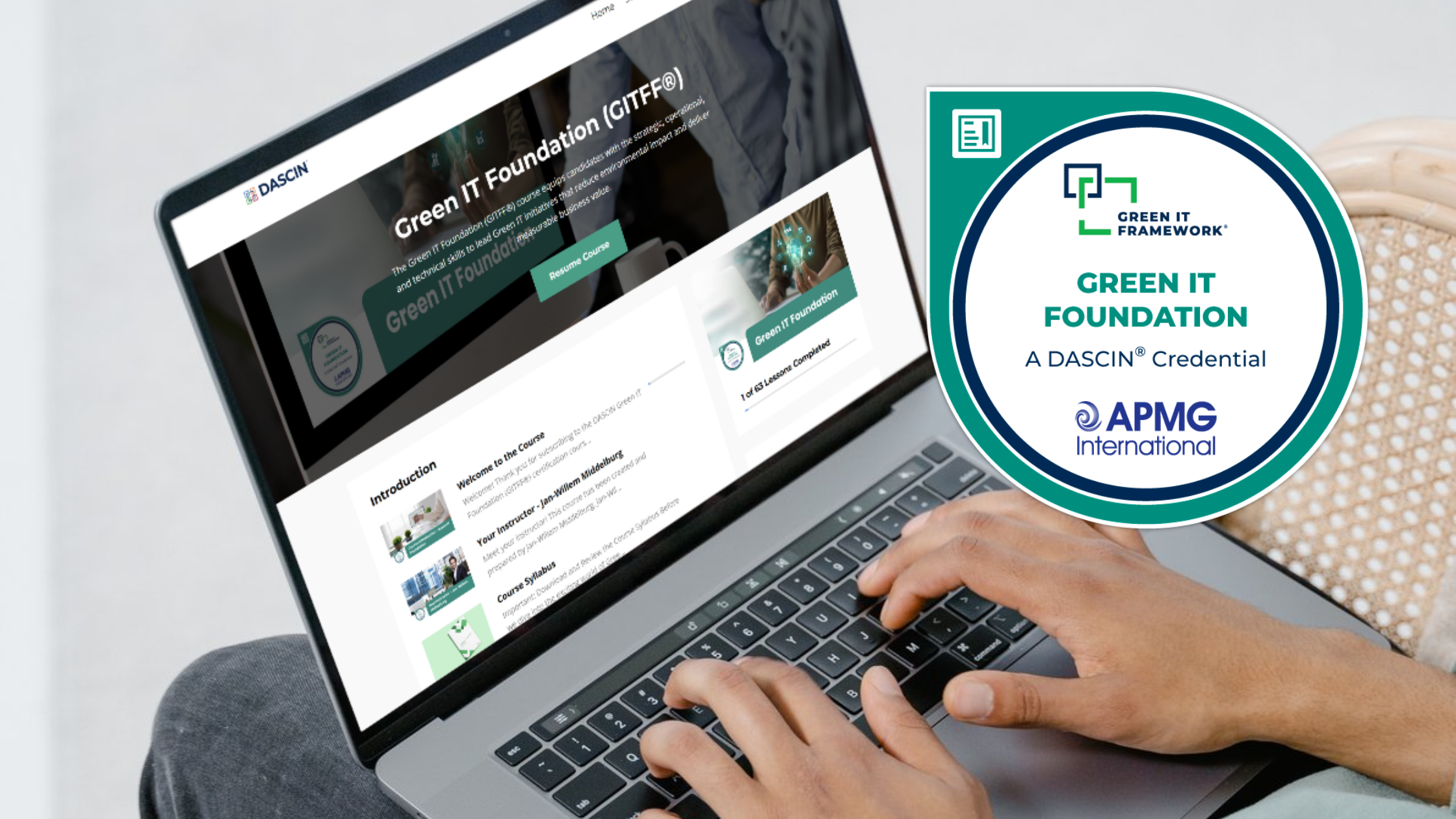
DASCIN® has launched the Green IT Foundation (GITFF®) eLearning course, making the full certification program available online for the first time. Alongside the course launch, the companion practitioner’s guide, Implementing Green IT, is now in print. Certification exams, administered by APMG International, will be open for booking from the end of July 2026.
The Green IT Foundation certification has been in development since early 2025, and this month marks the moment the full programme becomes accessible: both the learning and the credential. For professionals who have been following the Green IT Framework since it was first published, the path to certification is now open.
What is the Green IT Foundation certification?
GITFF® is DASCIN’s practitioner-level certification for sustainable IT. Where the introductory Green IT Awareness (GITA®) certificate focuses on building familiarity with sustainability concepts, the Foundation goes further, into the strategic, operational, and technical dimensions of actually implementing a Green IT program inside an organization.
The syllabus covers four areas: the environmental rationale behind Green IT; the structure and strategic use of the Green IT Framework; sustainable IT practices across software, infrastructure, and operations; and metrics, reporting, and continual improvement. By the end, candidates are equipped not just to understand what Green IT is, but to assess an organization’s maturity, design a strategy, build a measurement framework, and lead implementation across five operational domains.
No prior certification is required. While GITFF® builds on themes introduced in the GITA® programme, it is designed to be taken as a fully standalone credential.
The eLearning course: what’s included
The online course is self-paced and includes everything needed for both learning and exam preparation. The official textbook, Implementing Green IT: A Practitioner’s Guide, is embedded directly into the learning platform, so there is no separate purchase required. The exam is closed-book, and the guide is the primary study resource.
The exam: format and what to expect
The GITFF® examination is delivered by APMG International, one of the world’s leading examination and accreditation bodies. It is a closed-book exam: the practitioner’s guide may be used for study but is not permitted during the examination itself. Candidates who engage deeply with the guide’s worked examples, formulae, and case studies will be well placed to demonstrate both recall and understanding.
DURATION
60 min
75 min for non-native speakers (+25%)
PASS MARK
26/40
65%, no negative marking
QUESTIONS
40
Multiple-choice, one mark each
FORMAT
Closed Book
Classic, negative, missing word, and list question types
The exam draws on all four syllabus areas (environmental rationale, framework structure and strategy, sustainable IT practices, and metrics and reporting), with questions spanning recall of core concepts through to demonstrating understanding in practical enterprise contexts.
Booking opens in July via APMG International
Exam bookings will be available through APMG International from the end of July 2026. APMG administers the certification under its global accreditation infrastructure, ensuring the credential is independently verified and globally recognized. Candidates who complete the eLearning now will be ready to sit the examination as soon as the booking window opens.
The exam draws on all four syllabus areas (environmental rationale, framework structure and strategy, sustainable IT practices, and metrics and reporting), with questions spanning recall of core concepts through to demonstrating understanding in practical enterprise contexts.
Exam booking
GITFF® examinations will be bookable via APMG International from the end of July 2026. Organizations interested in becoming an Accredited Training Organization (ATO) should contact DASCIN directly at info@dascin.org.
The book: Implementing Green IT
Implementing Green IT: A Practitioner’s Guide is available now. It is the primary reference material for the GITFF® certification and is structured to support both exam preparation and real-world program implementation, across seven chapters that follow the full lifecycle of a Green IT program from initial assessment and business case through strategy design, measurement framework construction, domain-level implementation across hardware, software, processes, practices, and data storage, through to reporting and continual improvement.
The book is included with the eLearning course. It is also available as a standalone publication for practitioners who want the reference without the certification pathway, or organizations building their own internal Green IT knowledge base.
The guide is designed to be used alongside the certification, but it is also a standalone operational reference. The worked examples, measurement formulae, and case studies are practical tools, not just exam preparation.


