

Service expectations have changed dramatically. Speed, consistency, and seamless digital experiences are now the baseline, not the exception. Organizations are no longer evaluated purely on what they deliver, but increasingly on how efficiently and reliably they deliver it.
As a result, service design and automation have become central to how modern organizations operate, shifting focus from isolated process improvements to fully integrated service experiences that combine users, technology, and operational execution into a single coherent system.
The Service Automation Framework (SAF) provides a structured way to design and manage this shift. Rather than treating automation as a series of disconnected tools, SAF approaches it as a complete service ecosystem — connecting user behavior, service design, technology interfaces, and backend processes into one model that supports scalable and consistent service delivery.
Understanding the Service Automation Framework
At its core, the Service Automation Framework is a structured methodology for designing automated services in a way that balances user experience with operational efficiency. It was created to address a common challenge: organizations often automate individual tasks without considering how those tasks form part of a broader service journey.
SAF reframes automation as a complete service lifecycle, starting with understanding the user, continuing through digital interfaces and automated workflows, and extending into backend support processes that ensure consistent execution.
Why Traditional Automation Approaches Fall Short
Many organizations begin their automation journey by focusing on efficiency gains — identify repetitive tasks, introduce tools, measure success in time saved or cost reduced. While this delivers short-term value, it often fails to scale effectively.
The reason is structural: automation without architecture creates complexity rather than reducing it. Systems become fragmented, user journeys become inconsistent, and support processes become reactive rather than proactive. Over time, this creates an ever-growing gap between user expectations and organizational delivery.
The Foundation of SAF: The Service Automation Blueprint
A central concept within SAF is the Service Automation Blueprint — a visual and structural representation of how a service is delivered from start to finish. Rather than focusing solely on internal processes, the blueprint begins with the user journey and maps how each interaction is supported by technology and backend processes.
At a high level, the blueprint brings together five key dimensions:

The Three Design Lines That Shape Service Experience
Within SAF, service delivery is structured around three interconnected design lines that define how users interact with automated services.
- 1
Line of Trust
The relationship between the user and the service provider. Trust is not created through a single interaction, but through consistent experiences, reliable outcomes, and clear communication. In automated environments, trust becomes even more critical because users often interact with systems rather than people. - 2
Line of Interaction
All touchpoints between the user and the technology interface — web portals, mobile applications, chat systems, and automated notifications. This is where the user experience is most directly shaped. - 3
Line of Automation
The layer that operates behind the scenes, connecting technology interfaces to backend support processes. While users rarely see this layer directly, it has a major impact on performance, reliability, and scalability.
"Services should be designed around users, not around internal systems."
Designing for the User, Not the System
A key principle in SAF is that services should be designed around users rather than internal systems. This requires a deeper understanding of both demographics and psychographics — going well beyond basic user segmentation.
By combining these insights with user actions and service journeys, organizations can design experiences that feel intuitive and aligned with real user needs — reducing friction and increasing adoption, particularly in self-service environments.
Technology as the Service Interface
Within SAF, technology is not treated as a supporting tool but as the primary interface between users and services. In many modern organizations, this is the only interaction point users will ever have with the service provider.
This places significant importance on the design and reliability of self-service portals, mobile applications, and digital platforms, which must be intuitive, responsive, and capable of handling complex interactions without requiring human intervention.
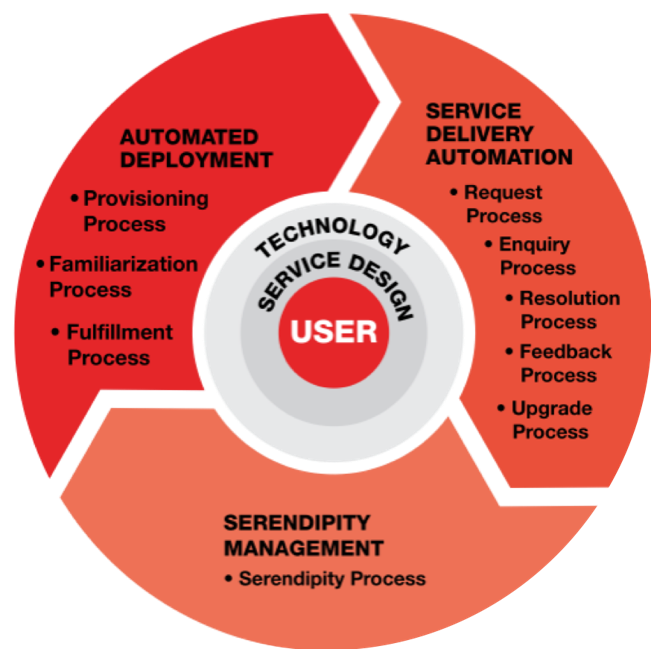
Automated Deployment and the First Service Experience
The beginning of any service experience plays a critical role in shaping user perception. SAF emphasizes this through Automated Deployment, focusing on initial setup, onboarding, and familiarization.
Service Delivery and Automation at Scale
Once a service is active, the focus shifts to ongoing delivery. SAF emphasizes the importance of service delivery automation — where core service interactions are executed through structured and repeatable processes. At this stage, automation is not just about efficiency; it’s about ensuring consistency across every interaction.
This is also where scalability becomes essential. As usage grows, manual intervention becomes unsustainable. Automated service delivery ensures organizations can handle increased demand without compromising quality.
The Role of Intelligent and Serendipitous Automation
Beyond structured workflows, SAF introduces the concept of serendipity processes — delivering unexpected value through intelligent automation and data-driven insights.
The Future of Service Automation
Service automation is evolving rapidly as technologies such as artificial intelligence, machine learning, and cloud computing become more deeply integrated into enterprise systems.
Future service environments will likely be defined by autonomous workflows, predictive service delivery, and adaptive user experiences. In this context, frameworks like SAF become even more important because they provide the structural foundation needed to manage increasing complexity.
Rather than replacing human involvement entirely, the future of service automation is about designing systems that enhance decision-making, reduce friction, and continuously improve service outcomes.
 The Service Automation Foundation equips professionals with the methodology to design automation across the full service lifecycle, from user experience and digital interfaces through to backend processes and intelligent service delivery.
Accredited by APMG-International and recognized across 37 countries.

