Artificial Intelligence (AI)
Artificial Intelligence (AI) builds on the power of Big Data to create intelligent systems that can learn, predict, and act. Explore how AI evolved, its real-world applications, and why mastering Big Data fundamentals is key to AI success.

Why Artificial Intelligence (AI) Matters in the Era of Big Data
Many large tech organizations envision Artificial Intelligence (AI) as a new wave of economic potential that provides growth potential for large enterprises. AI is now recognized as a key driver of digital transformation, enabling automation, optimization, and intelligent decision-making across industries.
AI builds on the capabilities and knowledge of Big Data, leveraging vast datasets to uncover insights and patterns that drive smarter business outcomes. It is therefore important to have a solid foundation of this topic before advancing into AI-driven innovation.
A History of AI
Artificial Intelligence (popularly referred to as AI) is intelligence displayed by machines, in contrast to the natural intelligence (NI) displayed by human and other animals. The domain of AI was first envisioned by a handful of computer scientists at the Dartmouth conferences in 1956, and has seen an explosive growth, especially since 2015.
Over the decades, AI has evolved from theoretical concepts into practical technologies that shape modern life — from predictive analytics to virtual assistants and recommendation systems.
Whereas AI can be considered a complete domain of science by itself, it is strongly interwoven with Big Data because the volume and variety of data sources are often massive (in terms of volume) and diverse (in terms of sensors). Additionally, many of the statistical and machine learning algorithms that are used to analyze Big Data sets are similar to the ones used in Artificial Intelligence.
This interconnection makes Big Data an essential enabler of AI, providing the raw materials required for machine learning and intelligent automation.
An Evolution of AI
The knowledge domain of Artificial Intelligence has evolved over the years to include Machine Learning algorithms and finally Deep Learning, which is driving today’s AI explosion.
In the course of the evolution of Artificial Intelligence, the underlying algorithms have become more complex and omnipotent. Besides its technical challenges and complexity, Artificial Intelligence also raises many sociological and ethical questions that makes the subject even more complex.
These developments have not only advanced computational capabilities but have also intensified discussions around AI ethics, bias, transparency, and governance.
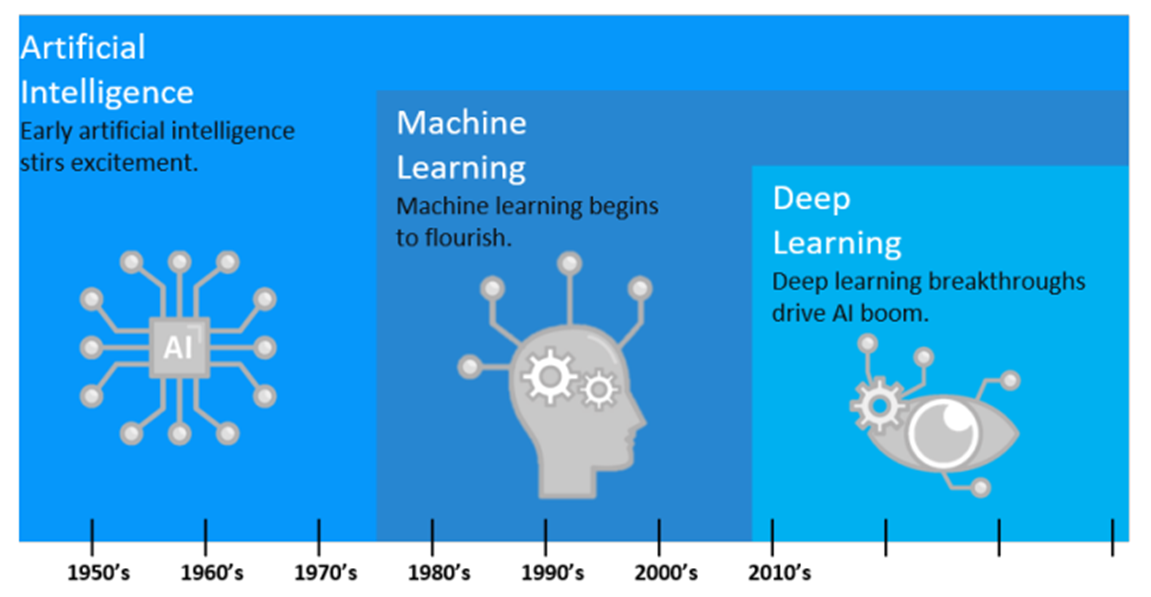
Figure 1: The evolution of AI, Machine Learning and Deep Learning
An Example of AI Application
A popular example of the application of AI is self-driving cars. The final objective of self-driving cars is to mimic the exact same behaviors as ‘natural’ people would make whilst driving (or preferably even better behavior without any accidents). The input data that have to be processed need to come from different sensors (high variety) and needs to process thousands of signals every single second (high velocity and high volume) as traffic situations change.
This showcases how AI systems combine perception, prediction, and decision-making in real-time — all powered by Big Data analytics.

Figure 2: Example of self-driving car
The Connection Between AI and Big Data
Artificial Intelligence and Big Data are deeply interdependent. Big Data provides the vast quantities of information that fuel AI learning, while AI delivers the intelligence to analyze, interpret, and act upon that data. Organizations that successfully integrate AI with Big Data gain measurable advantages improving efficiency, customer experiences, and innovation.

Knowledge - Certification - Community