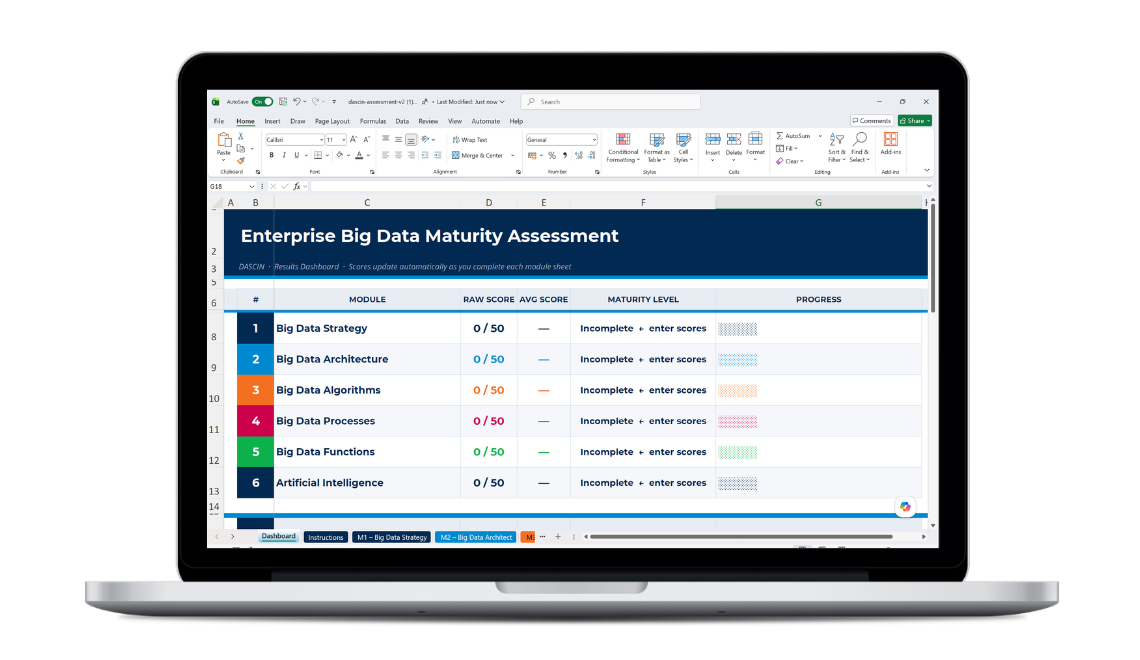
Most organizations know they should be doing more with data. Far fewer can say, with any precision, where their biggest gaps actually are. This free assessment gives you a structured, 20-minute way to find out.
Built on a proven framework, not guesswork
The assessment isn’t a list of questions we came up with over coffee. It’s drawn directly from the Enterprise Big Data Framework, developed by Jan-Willem Middelburg, Director at DASCIN, and published in his book The Enterprise Big Data Framework: Building Critical Capabilities to Win in the Data Economy.
The framework breaks enterprise data capability into distinct domains, each with its own set of practices, skills, and governance requirements that organizations need to build deliberately. Rather than treating “big data” as a single, vague initiative owned by IT, the framework treats it as a set of interconnected organizational capabilities, much like finance, HR, or operations, that mature over time.
The free assessment pulls the essential diagnostic questions from six of the framework’s capability domains. It’s intentionally short: a fast way to get a directional read on your organization’s maturity. The book goes much deeper into the full methodology behind every capability area.
What the assessment covers
The tool walks you through 60 statements across six modules, drawn straight from the framework. For each one, you score your organization from 0 to 5 using the Capability Maturity Model scale shown above, from Non-existent up to Optimized. A dashboard calculates your average per module and your overall maturity level automatically.
Why this matters for your organization
The real value of the EBDP for a Program Manager is not the certificate. It is what you do differently the Monday after you finish it. Based on how the course has played out in practice, here is what you can expect to change.
- 1
It replaces opinion with a shared reference point.
Ask five people in an organization how mature its data capability is and you’ll often get five different answers. A structured assessment gives everyone the same yardstick.
- 2
It shows where to focus first.
Most organizations aren’t uniformly behind or ahead; they’re strong in one or two areas and noticeably weaker in others. Seeing all six modules scored side by side makes it obvious where the next investment will have the most impact.
- 3
It supports the business case for change.
A single overall score, backed by a recognized framework, is a much easier thing to bring to leadership than a general sense that the organization should be doing more with data.
- 4
It gives you a baseline to track against.
Because the questions and scoring scale are fixed, you can retake the assessment in six or twelve months and see, in concrete terms, whether your investments are moving the needle.
- 5
It’s a low-risk way to start the conversation.
No consultants or lengthy audit required to get a first read on maturity. The self-assessment format means any team can run it internally, on its own schedule.
Get your copy
All six modules, the scoring guide, and the automated results dashboard, free to download. Complete it with your team and use the results to shape your next data or AI initiative.