Green IT in Practice: Use cases across the framework
Discover practical Green IT use cases and strategies that help organisations reduce environmental impact, improve energy efficiency, and build more sustainable technology operations.
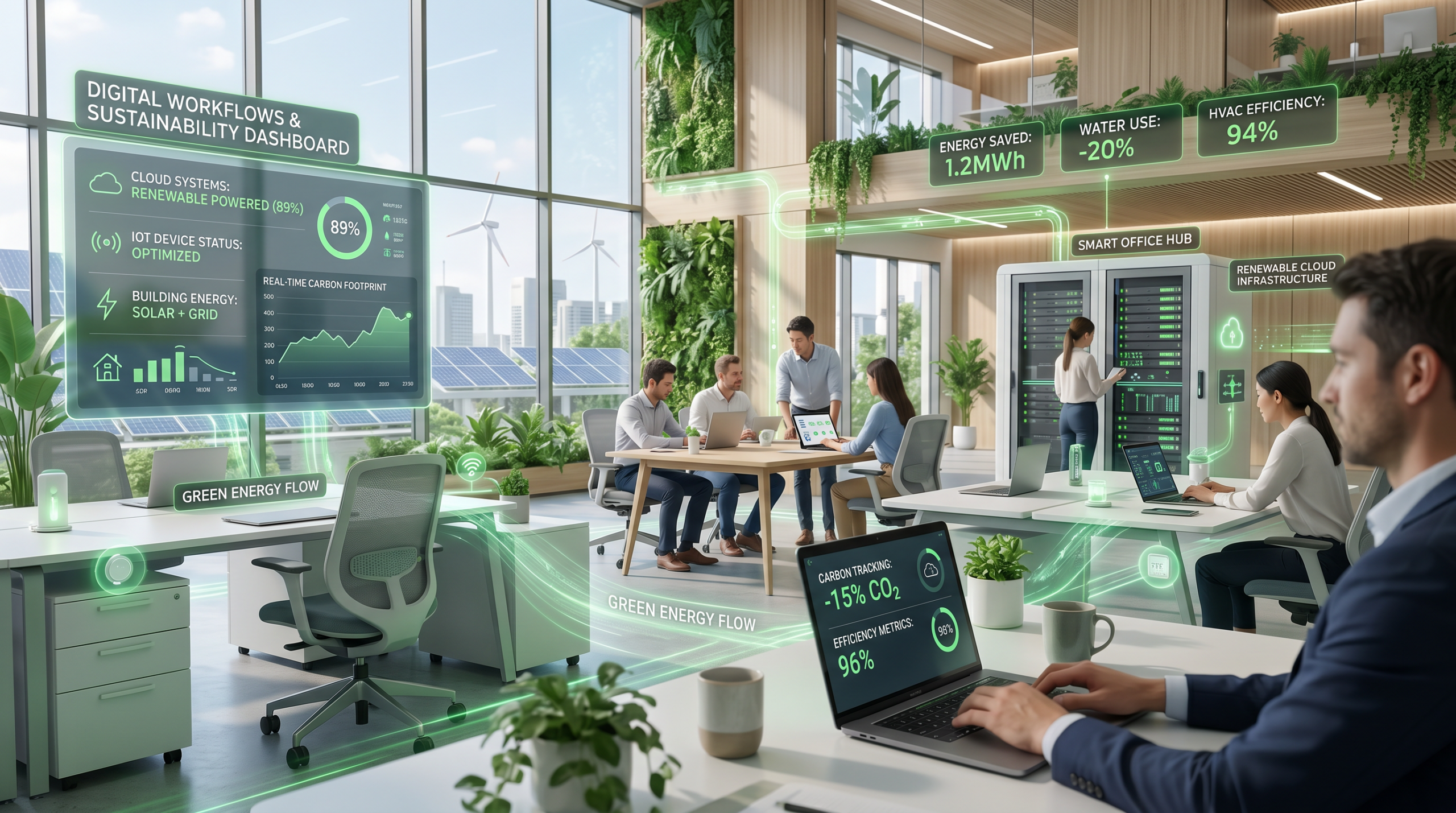
Quick wins and structural initiatives
One of the most practically valuable outputs of an initial Green IT assessment is a clear distinction between two categories of action: quick wins that can be implemented rapidly, at low cost, and with immediate measurable impact; and long-term structural initiatives that require sustained investment and organisational effort but deliver the greatest environmental gains over time.
This distinction matters both operationally and politically. Early visible results build credibility and momentum for harder, longer-term work. A well-sequenced Green IT roadmap uses quick wins to demonstrate that the programme delivers, while laying the technical and governance groundwork for structural change.
Quick wins — weeks to implement
Structural initiatives — months to years
The pattern that works is to use quick win savings to fund the next tier of structural investment. Phased implementation spreads cost across planning cycles and builds the financial evidence needed to secure larger budgets.
Lifecycle extension and responsible disposal
Hardware domain
Hardware generates environmental impact at every stage of its life, in manufacturing, through operation, and at disposal. Most organisations focus on the operational phase, but the embodied carbon in manufacturing is substantial: raw material extraction, energy-intensive production processes, and global transport all generate emissions before a device is ever switched on. Maximising the useful life of each device, and ensuring responsible disposal, are therefore two of the most impactful hardware interventions available.
These shifts require analytical thinking, operational insight, and conceptual understanding of automation principles.
Low implementation cost Policy & process change
Device lifecycle extension and internal redistribution
The most overlooked hardware sustainability opportunity is internal device redistribution — systematically reallocating devices from high-performance users to those whose needs can be met by older equipment, rather than retiring functional hardware simply because it no longer meets the needs of its current user.
Implementation requires classifying device use cases by performance requirement: developers, data scientists, and video editors need high-specification equipment; administrative, document-processing, and communications roles can typically be served by older hardware. A device grading process assesses the condition and remaining capability of vacated devices, and a distribution process matches them to appropriate use cases before defaulting to new procurement.
Extending the average device replacement cycle by even one to two years meaningfully reduces procurement frequency, the embodied carbon of new manufacturing, and the volume of e-waste generated, at relatively modest implementation cost. Organisations should also introduce deliberate friction into the replacement approval process: an explicit requirement to assess repairability before authorising replacement, and a system for tracking repair attempts and outcomes.
Regulatory compliance Requires partner selection
Certified IT asset disposal and circular economy
When devices do reach end of life, responsible disposal is essential. The environmental consequences of improper e-waste disposal are severe: hazardous materials including lead, mercury, cadmium, and hexavalent chromium are released into soil and water systems, with health consequences that persist for decades. Organisations have both ethical and regulatory obligations, in Europe, the WEEE Directive governs the disposal of electrical and electronic equipment.
The implementation priority is establishing a certified IT Asset Disposal (ITAD) partnership before significant volumes of devices reach retirement. Certified providers, under R2 (Responsible Recycling), e-Stewards, or equivalent standards, provide documented chain of custody for all retired devices, certified data destruction, and maximum material recovery through component reuse and recycling.
Before a device reaches an ITAD provider, organisations should consider the circular economy hierarchy: can the device be redeployed internally for a lower-demand use case? Can it be donated to a third-sector organisation? Can it be sold through a certified refurbisher? Each of these options extends the useful life of the device and its embedded materials, reducing the demand for new manufacturing.
Policy change Cross-functional coordination
Sustainable procurement: integrating environmental criteria into purchasing
Sustainable procurement means integrating environmental criteria directly into the procurement process, as mandatory compliance requirements for high-value or high-volume relationships, and as scored evaluation criteria in competitive tenders. Certifications including ENERGY STAR, EPEAT, and TCO Certified provide independently verified baselines for hardware energy efficiency and lifecycle sustainability.
Critically, sustainability criteria must carry sufficient weight in evaluation scoring to be a genuine differentiator. A criterion contributing 5% of the evaluation score will not meaningfully change procurement outcomes. A criterion contributing 20–30% will.
Virtualisation, efficiency, and carbon-aware scheduling
Software domain
Software’s environmental impact is diffuse and indirect, it manifests through the energy consumed by the hardware on which software runs, rather than through direct emissions. This makes it less visible than hardware or facilities, and less intuitively measurable. The use cases below address this challenge by identifying the specific software practices with the greatest impact on infrastructure energy consumption.
Structural initiative Capital investment required
Server virtualisation and consolidation
Virtualisation is the most impactful and broadly applicable software sustainability intervention available to organisations with on-premises or hybrid infrastructure. The typical enterprise server estate runs at 15–25% average utilisation, meaning 75–85% of provisioned capacity is idle at any given time. Virtualisation reduces this waste by enabling multiple workloads to share physical infrastructure, raising effective utilisation and thereby reducing energy consumed per unit of productive computation.
A thorough server consolidation programme begins with a complete inventory of all physical servers, including those previously excluded from virtualisation, and an assessment of each for feasibility. For virtualizable servers, the target is consolidation onto the smallest number of physical hosts consistent with performance requirements and fault tolerance. Organisations should target a minimum average utilisation of 60% across the virtual estate, and should decommission physical hosts as workloads migrate rather than retaining them as spare capacity.
Structural initiative Requires careful planning
Cloud migration as a sustainability strategy
Cloud migration can be a highly effective sustainability strategy, but only when executed with environmental criteria integrated into the migration plan. The sustainability benefits derive from two sources: the operational efficiency advantages hyperscale cloud providers have achieved through economies of scale (leading facilities operate at PUE values below 1.2); and their growing renewable energy portfolios, substantially higher than the typical grid mix available to organisations running their own data centres.
However, cloud migration is not automatically a sustainability improvement. Poorly managed migrations, those that lift-and-shift on-premises workloads without optimisation, or that result in over-provisioned cloud instances running at low utilisation, can generate as much energy waste in the cloud as they eliminated on-premises. The sustainability benefit is only realised when workloads are right-sized, resources are actively managed, and idle or unused instances are terminated rather than left running.
Emerging practice Tooling available
Carbon-aware workload scheduling
Carbon-aware computing schedules deferrable workloads to run during periods when the carbon intensity of the electricity grid is lower, typically overnight, when renewable generation (wind and solar) is higher relative to demand. The same computational task running at 2am may generate significantly less carbon than at 6pm during peak demand, without changing the work performed or the resources consumed.
Deferrable workloads, those that need to complete within a defined window but do not need to start at a specific time, are the primary targets. These include batch data processing, database backup and replication, model training and inference batch jobs, large file transfers, data synchronisation, and software update deployment. Tools for implementation include the Carbon Aware SDK from the Green Software Foundation, and commercial cloud scheduling services integrating grid carbon intensity data from providers including Electricity Maps and WattTime.
Near-zero cost Immediate impact
Automated shutdown and endpoint power management
Automated power management and workload scheduling are among the highest-return, lowest-cost software sustainability interventions available. Research shows that if all office computing equipment were configured for low-power operation, energy consumption could be reduced by up to 23%, achievable through software configuration changes alone.
Modern endpoint management platforms (Microsoft Intune, Jamf, and equivalents) can enforce power management settings across thousands of devices simultaneously through centrally administered policy: automatic screen timeout, sleep or hibernate after inactivity, scheduled shutdown at end of day, and wake-on-LAN for maintenance tasks. The implementation challenge is primarily organisational, managing exceptions, help desk load, and the cultural friction of changing device behaviour that users have previously controlled themselves.
Hybrid working, paperless operations, and renewable energy
Processes domain
The processes domain covers organisational operating practices that generate IT-related emissions, principally commuting, paper-intensive workflows, and the source of energy powering IT operations. These use cases sit at the intersection of IT and facilities management, and often require cross-functional coordination to implement effectively.
Policy change People & culture dimension
Hybrid and remote working policy
Commuting, primarily by private vehicle, is a significant source of carbon emissions attributable to IT-heavy workforces. Remote and hybrid working policies directly reduce commuting frequency and associated emissions, and can allow a reduction in the physical office footprint, eliminating the ongoing energy and carbon overhead of underutilised office space.
Organisations seeking to maximise the sustainability impact of hybrid working should design policies to maximise permissible remote working days, subject to the operational and collaboration requirements of each role. Beyond the policy document itself, effective implementation requires attention to technology provision (reliable remote access and collaboration tools), home working energy guidance (ensuring reduced commuting emissions are not offset by increased home energy consumption), and workplace reconfiguration as office attendance falls.
Process redesign Tools widely available
Paperless office implementation
The paperless office is a goal many organisations have declared and few have fully achieved. The implementation challenge is not typically technical, the tools to digitise virtually all paper-based workflows exist and are accessible. It is cultural and process-related: paper often persists because the digital alternative requires a workflow change that has not been explicitly designed and socialised.
Effective implementation focuses on mapping the document-intensive processes where paper use is concentrated, approvals, HR documentation, procurement, client reporting, and designing digital replacements that are as easy to use as their paper equivalents. Default printer settings changed to duplex and black-and-white are a low-cost, immediate reduction in paper consumption that requires no workflow redesign.
Structural initiative Commercial negotiation required
Renewable energy procurement for IT operations
For organisations with significant on-premises IT infrastructure, the source of electricity powering that infrastructure is one of the largest determinants of its carbon footprint. Renewable energy procurement, through green electricity tariffs, Power Purchase Agreements (PPAs) with renewable generators, or Renewable Energy Certificates (RECs), directly reduces the carbon intensity of IT operations.
PPAs, which are direct long-term supply contracts between an organisation and a renewable energy generator, typically offer the most robust environmental claims (because they fund new renewable generation rather than simply purchasing certificates in the market) and are increasingly accessible to mid-sized organisations through aggregated PPA structures. The renewable energy as a percentage of IT electricity is a standard reported KPI in the Green IT framework.
Power management and sustainable design
Practices domain
The practices domain covers the human and cultural dimensions of Green IT, the behaviours, standards, and norms that determine how technology is used day to day across the organisation. It is the component most influenced by leadership visibility and the effectiveness of training, and the one that most quickly loses ground if commitment is not sustained.
23%
potential energy reduction if all office equipment configured for low-power operation
2–80×
difference in energy per computation between compiled and interpreted languages
20–30%
minimum procurement score weight for sustainability criteria to drive real change
Near-zero cost Rapid deployment
Idle device management and power settings at scale
Devices left on, awake, or at full power outside working hours, monitors not going to sleep, servers not throttling, workstations not shutting down, represent continuous and unnecessary energy consumption. Idle device management addresses this through a combination of centrally enforced power policy and a culture of personal responsibility supported by awareness training.
Centrally managed power policy (through endpoint management platforms) handles most devices automatically. Awareness training addresses the edge cases and builds the behavioural habits, powering down devices at the end of the day, managing monitor brightness, reporting devices that do not appear to be following power policy, that automated tools alone cannot cover.
Process embedding Developer culture change
Eco-design standards in software development and procurement
Eco-design means embedding sustainability criteria into the design of software systems, hardware configurations, and physical office environments, as standard requirements rather than optional considerations. In software development, this includes language and framework selection for computationally intensive components. Research consistently shows that compiled languages such as C, C++, Rust, and Go consume significantly less energy per unit of computation than interpreted languages such as Python, Ruby, and JavaScript, with differences ranging from 2× to 80× depending on the task. For AI and data processing workloads in particular, language selection has material energy consequences.
In procurement, eco-design standards mean specifying sustainability criteria, energy efficiency ratings, repairability scores, recycled material content, in procurement requirements, and ensuring those criteria have sufficient scoring weight to influence outcomes.
ROT deletion, tiered architecture, and green data centres
Data storage domain
Data storage has grown rapidly as an area of environmental concern as organisational data volumes have increased exponentially. The relationship between data volume and energy is direct: every terabyte stored consumes energy continuously from the moment it is written until the moment it is deleted, regardless of whether it is ever accessed. Managing data volume is therefore a direct environmental intervention.
High impact, low cost Requires policy and audit
Data lifecycle management and ROT data deletion
Data lifecycle management, the systematic governance of data from creation through storage, archiving, and deletion, is one of the highest-impact, lowest-cost sustainability interventions in the storage domain. Data that serves no operational purpose (redundant, obsolete, or trivial, ROT data) consumes energy indefinitely without delivering any business value.
A data retention and deletion programme requires four components: a retention policy defining how long each data category should be retained and the legal basis for doing so; a regular data audit process using automated discovery tools; a controlled deletion process with appropriate approvals and legal holds verification; and a data creation governance process to reduce the volume of ROT data generated in the first place, through file naming conventions, version control, and email and collaboration policies that discourage unnecessary copies.
Technical implementation Storage platform investment
Tiered storage architecture
Not all data has the same access frequency, performance requirements, or business criticality, and not all storage infrastructure has the same energy characteristics. Tiered storage architecture aligns data with the storage tier whose cost and energy profile matches its actual access pattern: frequently accessed operational data on fast, energy-intensive storage (SSD or NVMe); less frequently accessed reference data on lower-energy storage (SATA HDD or object storage); and rarely accessed archival data on the lowest-energy tier (cold object storage, tape, or off-site archive).
Implementation requires data classification by access frequency and retention tier, storage platform configuration to support automated data movement between tiers (typically managed by storage management software or cloud lifecycle policies), and monitoring of tier migration activity.
Structural decision Measurable KPI impact
Green data centre selection and PUE optimisation
Power Usage Effectiveness (PUE) is the primary metric for data centre efficiency, the ratio of total facility energy to the energy consumed by IT equipment alone. A PUE of 2.0 means that for every unit of energy used by IT equipment, a further unit is consumed by cooling, lighting, and other overhead. Industry target is below 1.5; best-in-class facilities operate below 1.2. In one documented case, an organisation’s data centre was found to have a PUE of 2.3, meaning cooling consumed 1.3 units of energy for every unit used by IT equipment. This single finding redirected the organisation’s entire Green IT roadmap, moving data centre modernisation to the top of the priority list.
For organisations selecting cloud or colocation providers, sustainability criteria, PUE, renewable energy percentage, certifications such as ISO/IEC 30134, LEED, and ENERGY STAR, should be explicitly assessed at contract stage and monitored through the relationship. Water Usage Effectiveness (WUE), measured in litres of water per kWh of IT load, is an increasingly important secondary metric as data centre water consumption draws regulatory attention in water-scarce regions.
Quick wins funding structural change
Case study
The following case example is drawn from the DASCIN® practitioner’s guide. It illustrates how organisations with no dedicated Green IT budget can use a phased, self-funding approach to build both financial evidence and programme credibility, before progressing to capital-intensive structural initiatives.
A 1,200-person firm operating under a zero-net-cost mandate in Year 1
A mid-sized professional services firm launched its Green IT programme under a constraint common in many organisations: the finance directorate would not approve dedicated programme investment. All Year 1 activity had to be funded from the savings it generated. The programme team identified four initiatives that met this criterion, each requiring either zero or minimal capital outlay while delivering measurable, immediate energy and cost savings.
£116k
Combined Year 1 annual savings
£12k
Total Year 1 implementation cost
867%
Return on investment, Year 1
This pattern, zero-cost and low-cost initiatives generating savings that fund the next tier of investment, is replicable across organisations of most sizes. The constraint is not budget; it is having a structured method for identifying, prioritising, and measuring the right initiatives.
Further learning
The use cases in this article are drawn from Implementing Green IT: A Practitioner Guide published by DASCIN®, which covers each domain in full implementation detail including measurement formulae, assessment tools, and governance templates. For a structured introduction to the Green IT Framework and the skills to apply it, DASCIN® offers the:
Knowledge - Certification - Community