What Is a Data Governance Framework?
A data governance framework is a structured set of principles, components, roles and processes that provides a coherent, repeatable approach to governing an organisation's data. It is the architecture, not the activity: it is what determines whether individual governance efforts, a data quality fix here, a compliance project there, add up to a capability the organisation can rely on, or stay a collection of disconnected initiatives.

In brief
- Gartner predicts that by 2027, 80 per cent of data and analytics governance initiatives will fail, largely because they are not connected to a real business outcome or a genuine sense of urgency (Gartner, 2024).
- An independent practitioner survey of 111 data governance professionals found unclear ownership and roles cited as a top challenge by 45 per cent of respondents, and getting the business to actually change its habits cited by 61 per cent (Ledoux, 2026).
- A framework is the architecture for governance, not a single policy, standard or tool. Confusing the two is one of the most common reasons governance work never becomes a lasting capability.
- Gartner predicts that by 2028, half of organisations will adopt a zero-trust posture towards data governance because of the volume of unverified, AI-generated data now entering their systems (Gartner, 2026a).
- Uber’s own engineering team built its governance around two working principles: every dataset is owned by a business or functional team, and every schema change goes through a review process, treating data the way software teams treat code (Uber Engineering).
What is a data governance framework?
Most organisations do not lack data governance activity. They lack a way to tell whether that activity adds up to anything. A data quality fix here, a privacy compliance project there, a master data clean-up somewhere else: each is defensible on its own, and none of them, taken alone, builds a capability the organisation can still rely on next year. A framework exists to solve that specific problem. It is not another initiative to run alongside the others. It is the structure that lets an organisation decide, in advance, what coherent governance actually looks like, so that individual projects can be judged against a shared standard rather than only against their own local success.
The evidence for why this matters is stark. Gartner predicts that by 2027, 80 per cent of data and analytics governance initiatives will fail, and attributes this primarily to a lack of connection to business outcomes rather than to any technical shortfall. Saul Judah, VP Analyst at Gartner, put it directly: “A D&A governance program that does not enable prioritized business outcomes fails” (Gartner, 2024). That is a description of exactly the failure mode a framework is designed to prevent: governance work that is real, often well-intentioned, and structurally unable to persist because nothing ties it to a shared architecture or a business result anyone is accountable for.
Several data governance frameworks exist publicly, and they overlap more than they differ. The detail that actually predicts success is not which one an organisation picks. It is whether the organisation picks one and sticks with it: the same vocabulary and the same components applied consistently over years, rather than swapped out whenever a new hire or a new consultant prefers a different model. A framework abandoned halfway through implementation, or replaced every year or two, tends to leave behind exactly the fragmented governance it was meant to fix.
Framework, policy, standard and control: what is the difference?
These four terms are often used loosely, and the confusion causes real implementation problems, because each one plays a different role and none of them substitutes for another.
| Term | What it is | Example |
|---|---|---|
| Governance framework | The overall architecture, not any one output of it. It determines how roles, rules and daily practice fit together, rather than being one of those things itself. | The three-layer structure described below |
| Data policy | A rule the organisation has formally committed to, covering one specific aspect of how data must be handled, with the authority to require compliance. | A rule stating who may access which category of data, and under what conditions |
| Data standard | The concrete specification for how a piece of data should look: its format, naming, precision, the kind of thing a system can actually be checked against. | A required format for customer date-of-birth fields |
| Governance process | A repeatable workflow for carrying out one governance activity, with defined inputs, decision points and named responsibility at each step. | The workflow for escalating and resolving a reported data quality issue |
| Technical control | The system-level mechanism, a validation rule, an access restriction, an audit log, that actually enforces a policy or standard rather than merely documenting it. | A referential integrity constraint in a database |
Table 1. How a framework relates to the instruments it governs.
A useful test: a standard that conflicts with an existing policy, or cannot be implemented within the current governance process, is not yet an operational governance instrument, however well it is documented. Policy, process and technical control are required simultaneously, and any one alone is insufficient. Uber’s own engineering team describes this in practice through two working principles: data is treated as code, meaning schema changes go through the same review process as software changes, and data is owned, meaning every dataset has a named business or functional owner (Uber Engineering). Neither principle works without the other. Ownership without a review process has no enforcement mechanism, and a review process with no named owner has nobody to review against.
The core components of a data governance framework
DASCIN’s own model organises the components of a working framework into three layers, moving from authority at the top to measurable outcomes at the bottom. These layers are not sequential steps in a process. They operate simultaneously and interdependently: the top layer directs, the middle layer operationalises, and the bottom layer delivers.
| Layer | Components | What it does |
|---|---|---|
| Leadership and authority | Governance body, strategy review, roles and responsibilities, legal and regulatory alignment, risk management | Decides what the governance programme is trying to achieve, who is accountable for what, and how the programme responds to external obligations and internal risk. This is the layer at which authority is exercised, not merely referenced. |
| Operational governance | Standards, policies and processes | Translates the authority established above into the instruments through which governance is actually practised: what good data looks like, how data must be handled, and how decisions are made, communicated and enforced. |
| Data quality outcomes | Measurable, observable properties such as accuracy, consistency, integrity, accessibility, availability, auditability, confidentiality, privacy and security | The point where governance becomes concrete. Not a policy in a document, but a demonstrable quality in the data itself. |
Table 2. The three layers of a working data governance framework.
The survey evidence on where governance actually breaks down lines up closely with this structure. An independent survey of 111 practitioners, run through the Data Governance Playbook newsletter in mid-2026, found unclear ownership and roles cited as a top challenge by 45 per cent of respondents, second only to getting the business to actually change its habits, cited by 61 per cent (Ledoux, 2026). Both failures sit squarely in the top layer. No amount of investment in standards or quality tooling compensates for a governance body with no real authority, or ownership that exists on an org chart but nowhere else.
The same survey found data governance reporting into IT or the CTO’s office in 43 per cent of organisations, against 26 per cent reporting to a dedicated Chief Data Officer, with the remainder scattered across business units, compliance and finance (Ledoux, 2026). Where governance sits organisationally is a real design choice, and it interacts directly with the leadership and authority layer: a governance body positioned inside IT can find it harder to compel compliance from business units that do not report into that same chain.
Roles and responsibilities inside the framework
A framework assigns decision rights as much as it assigns tasks. Getting the roles right matters more than getting the documentation right, and the same 2026 practitioner survey backs this up directly: respondents named sponsorship and ownership as the two most frequently repeated words in their open-text answers about what their governance programme actually needs (Ledoux, 2026). One respondent summarised the gap precisely: what is missing is “end-to-end process ownership and accountability linked to data objectives” (Ledoux, 2026).
How to build a data governance framework
Gartner’s own diagnosis of why governance programmes fail points away from the rigid, centrally-imposed model many organisations still default to. Its analysts describe the typical one-size-fits-all approach as no longer adequate, and recommend that programmes be rescoped around tangible business outcomes rather than run as a uniform, tactical, data-only exercise (Gartner, 2024). In the 2026 practitioner survey, the single most common stated priority for the year ahead, at 37 per cent of respondents, was fixing or rolling out the operating model itself, meaning roles and domains, ahead of any specific data quality or tooling initiative (Ledoux, 2026).
That priority ordering matches DASCIN’s own sequencing principle: build the authority layer before the operational layer, and the operational layer before investing heavily in outcomes. Organisations regularly invest in data quality monitoring before they have quality standards to measure against, or appoint data stewards before a governance body exists for stewards to escalate to. Each of these sequences produces investment that cannot deliver its intended value, because the governance foundations it depends on are not yet in place.
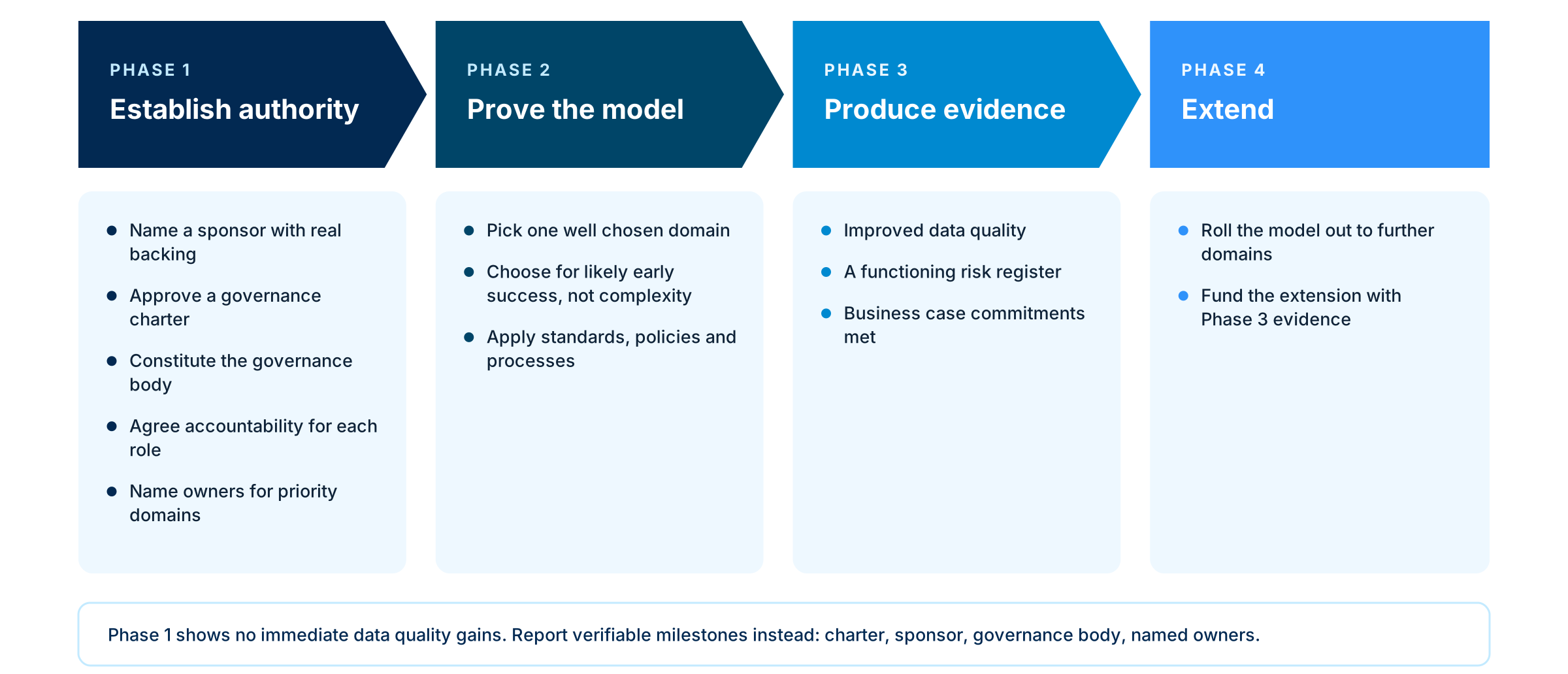
DASCIN’s own phased model for building that foundation runs in four stages. Phase 1 is devoted entirely to leadership and authority: naming a sponsor with real backing, defining who holds governance authority and how, getting a governance charter formally approved rather than just drafted, constituting the governance body with genuine terms of reference, agreeing accountability for each governance role, and naming owners for the first priority domains, before any standard or quality tool is introduced. Phase 2 proves the model in one well-chosen domain, selected for the likelihood of early, visible success rather than for how complex or politically significant it is. Phase 3 produces evidence, improved data quality, a functioning risk register, met business case commitments, and that evidence is what funds Phase 4’s extension to further domains.
None of Phase 1 produces an immediately visible improvement in data quality, which is exactly the stage where most programmes come under pressure to show something concrete. The credible answer to that pressure is not to skip ahead. It is to report verifiable milestones that are real even though they are not yet data quality improvements: a charter under formal consultation, a sponsor confirmed at board level, a governance body with terms of reference and a scheduled first meeting, and named owners for the first one or two domains.
How AI changes what a framework needs to do
AI does not replace the need for a governance framework. It depends on one, and it is expanding what the framework has to cover. Regulation is reinforcing this directly: the EU AI Act requires high-risk AI systems to be trained on data that meets defined quality standards, with demonstrable provenance and governance. Following the Digital Omnibus, obligations for stand-alone high-risk systems apply from 2 December 2027 and those for high-risk AI embedded in regulated products from 2 August 2028 (Gibson Dunn, 2026).
The more immediate pressure is volume rather than regulation. Gartner predicts that by 2028, half of organisations will adopt a zero-trust posture towards data governance specifically because of the growing volume of unverified, AI-generated data now entering enterprise systems. “Organizations can no longer implicitly trust data or assume it was human generated,” said Wan Fui Chan, Managing VP at Gartner (Gartner, 2026a). Its recommendation is not to build a separate AI governance function, but to extend the existing framework: update security, metadata management and ethics-related policies to account for the new risk, and adopt active metadata practices that can flag stale or unverified data in real time.
The cultural dimension of governance becomes more, not less, important as AI enters the picture. Gartner also predicts that by 2027, 60 per cent of organisations that fail to address the cultural challenges of data governance will fail to govern AI successfully, and recommends positioning governance as a business enabler rather than an IT responsibility (Gartner, 2026b). Looking further out, Gartner predicts that half of organisations will use autonomous AI agents by 2030 to translate governance policies and technical standards into machine-verifiable data contracts, and that half of AI agent deployment failures will stem from insufficient runtime enforcement in AI governance platforms (Gartner, 2026c). Automation changes how a framework’s policies get enforced. It does not change who is accountable for them: the human accountability structure in the leadership and authority layer stays intact however capable the tooling becomes.
Why data governance frameworks fail
The headline figure is severe enough to be worth restating on its own: Gartner predicts that by 2027, 80 per cent of data and analytics governance initiatives will fail (Gartner, 2024). The reasons behind that figure, and the independent practitioner survey evidence that sits alongside it, point to a small number of recurring, largely non-technical causes.
Frequently asked questions
Your Career Next
Turn your governance framework into a capability the organisation can rely on
The Data Governance Fundamentals certification is built around the Enterprise Big Data Framework, the same model behind the three layers described in this article. It builds the skills to design, launch and sustain governance that works in practice, not just on paper.
Sources
- Middelburg, J.-W. (2026) Data Governance Fundamentals. DASCIN (The Data Science Institute).
- Gartner (2024) ‘Gartner Predicts 80% of D&A Governance Initiatives Will Fail by 2027, Due to a Lack of a Real or Manufactured Crisis’, press release, 28 February 2024. https://www.gartner.com/en/newsroom/press-releases/2024-02-28-gartner-predicts-80-percent-of-data-and-analytics-governance-initiatives-will-fail-by-2027-due-to-a-lack-of-a-real-or-manufactured-crisis-
- Gartner (2026) ‘Gartner Predicts by 2028, 50% of Organizations Will Adopt Zero-Trust Data Governance as Unverified AI-Generated Data Grows’, press release, 21 January 2026. https://www.gartner.com/en/newsroom/press-releases/2026-01-21-gartner-predicts-by-2028-50-percent-of-organizations-will-adopt-zero-trust-data-governance-as-unverified-ai-generated-data-grows
- Gartner (2026) ‘Gartner Predicts 60% of Organizations That Ignore Data Governance Culture Challenges Will Fail to Govern AI Successfully by 2027’, press release, 21 September 2026. https://www.gartner.com/en/newsroom/press-releases/2026-09-21-gartner-predicts-60-percent-of-organizations-that-ignore-data-governance-culture-challenges-will-fail-to-govern-ai-successfully-by-2027
- Gartner (2026) ‘Gartner Announces Top Predictions for Data and Analytics in 2026’, press release, 11 March 2026. https://www.gartner.com/en/newsroom/press-releases/2026-03-11-gartner-announces-top-predictions-for-data-and-analytics-in-2026
- Gibson Dunn (2026) ‘EU AI Act Omnibus Agreement: Postponed High-Risk Deadlines and Other Key Changes’. https://www.gibsondunn.com/eu-ai-act-omnibus-agreement-postponed-high-risk-deadlines-and-other-key-changes/
- Ledoux, C. (2026) ‘The State of Data Governance 2026’, The Data Governance Playbook, Substack, survey of 111 practitioners, July to August 2026. https://thedatagovernanceplaybook.substack.com/p/the-state-of-data-governance-2026
- Uber Engineering, ‘Data in Practice: Systematizing Data Quality at Uber-Scale’ and ‘Turning Metadata Into Insights with Databook’, Uber engineering blog. https://www.uber.com/us/en/blog/metadata-insights-databook/
Statistics are reported as published by the named sources. Figures from surveys are not directly comparable across sources because samples and definitions differ.
Knowledge - Certification - Community