What Is the Carbon Footprint of AI? A Data Center Energy, Water, and Emissions Primer
Every AI model has a physical footprint. This primer explains how AI's electricity use, water consumption, and hardware lifecycle add up to a measurable carbon footprint, and how the DASCIN Green IT Framework helps you track and reduce it.
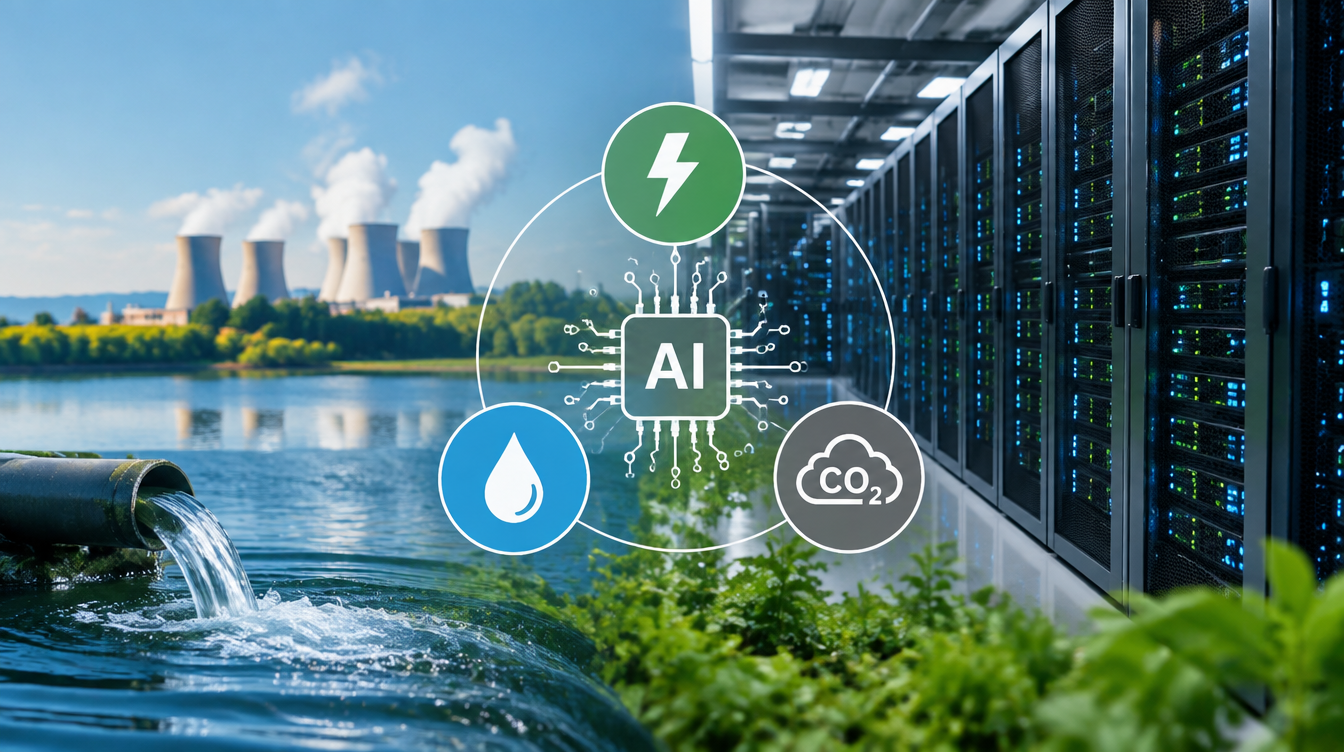
Every AI model, from a small classification tool to a frontier language model, has a physical footprint. Training and running that model consumes electricity, and in many cases water, at a real data center, and both of those inputs carry a carbon cost. As AI adoption spreads across the enterprise, understanding that footprint, and knowing how to measure and reduce it, has become a core competency for IT, sustainability, and data professionals alike.
What Is the Carbon Footprint of AI?
The carbon footprint of AI is the total greenhouse gas emissions generated across an AI system’s lifecycle, from the electricity used to train and run a model, to the water consumed for cooling the data center that houses it, to the emissions embedded in manufacturing the hardware itself. It is typically expressed in metric tons of carbon dioxide equivalent (CO2e) and is usually broken into two categories: operational emissions, tied to the electricity a data center draws while training and serving a model, and embodied emissions, tied to manufacturing, shipping, and eventually disposing of the servers and chips that make AI possible.
Understanding this concept sits squarely inside the DASCIN Green IT Framework, specifically its Measurement and Reporting component, which calls for organizations to track energy consumption and carbon emissions across their technology stack. AI simply makes that tracking more urgent, because AI workloads are structurally more energy- and water-intensive than the general-purpose computing that came before them.
Why this matters for enterprise strategy: AI’s environmental cost now affects cost (electricity and cooling are a growing line item in AI infrastructure spend), compliance (EU regulators are moving from voluntary to mandatory reporting), and procurement (enterprise buyers increasingly ask AI vendors for sustainability disclosures).
1. Energy Consumption
Electricity is the largest and most visible component of AI’s footprint. Global data center electricity consumption reached roughly 415 terawatt-hours (TWh) in 2024 and is projected to climb toward 945 to 1,050 TWh by 2030, with AI accelerator workloads driving most of that growth. A generative AI training cluster can draw several times more power than a typical enterprise computing workload, and the newest AI server racks require liquid cooling because they run far hotter than the air-cooled infrastructure most data centers were originally built for.
What drives AI’s energy intensity:
- Model size: Larger models with more parameters require more compute, and more compute means more electricity, both to train the model and to run it afterward.
- Training frequency: Every retraining cycle adds a fresh energy cost on top of the model’s ongoing inference footprint.
- Hardware generation: Newer GPUs are more energy-efficient per calculation, but they are also being deployed at a scale that outpaces those efficiency gains.
- Data center location: The carbon intensity of the electricity grid powering a data center has a direct impact on the emissions tied to any given workload.
2. Water Usage
Water is the least visible part of AI’s footprint, and the one most professionals have not been trained to ask about. Data centers use water in two ways: directly, through evaporative cooling systems that keep servers from overheating, and indirectly, through the water consumed by the power plants that generate their electricity.
Where AI’s water footprint comes from:
- On-site cooling: Estimates for the water cost of a single AI-generated response range from a few milliliters to tens of milliliters, and training a large language model can evaporate hundreds of thousands of liters of freshwater on site.
- Electricity generation: Thermoelectric power plants commonly use water for cooling, which means even air-cooled data centers carry an indirect water cost through their electricity supply.
- Regional water stress: A significant share of data centers built in recent years sit in regions already facing water stress, which is why water usage effectiveness (WUE) is becoming as important a metric as energy usage.
3. Carbon Emissions and the Hardware Lifecycle
Carbon emissions are the outcome of both the energy and water layers above, plus a third factor most organizations overlook: the embodied emissions in the hardware itself. Manufacturing GPUs, servers, and cooling infrastructure carries its own carbon cost, and AI hardware cycles through generations far faster than typical enterprise IT, which shortens replacement cycles and increases electronic waste.
Researchers project that AI-driven data center growth in the U.S. alone could add tens of millions of metric tons of CO2-equivalent emissions annually by 2030, depending on how quickly the electricity grid supplying that growth decarbonizes. This is why the Green IT Framework treats Hardware and Measurement and Reporting as distinct but connected components: reducing AI’s carbon footprint requires managing both the electricity it consumes and the physical lifecycle of the equipment that runs it.
4. Key Metrics to Know
Measuring AI’s environmental footprint requires a shared vocabulary. These are the metrics that show up most often in vendor disclosures, regulatory filings, and sustainability reports.
Fluency in these terms is a practical requirement, not just background knowledge. They are the same terms used in the DASCIN Green IT Foundation syllabus and in regulatory frameworks such as CSRD and the GHG Protocol.
5. Training vs. Inference
Training a model is a one-time, energy-intensive event. Training a large language model has been estimated to consume over 1,000 megawatt-hours of electricity and produce several hundred tons of CO2 equivalent before a single end user ever sends it a prompt. But training is not where most of AI’s footprint accumulates over a model’s life. Once deployed, inference, the ongoing, ordinary act of running the model to answer queries, becomes the dominant cost, multiplied across millions or billions of uses.
This distinction matters for procurement and governance. A model that is expensive to train but efficient at inference may have a smaller total footprint than a smaller model that is deployed inefficiently at massive scale. Evaluating AI vendors on training footprint alone misses the larger, ongoing cost of inference.
6. The Regulatory Landscape
AI’s environmental footprint is moving from voluntary disclosure to mandatory reporting. In the European Union, the Energy Efficiency Directive already requires data centers above a set power threshold to report annually on energy consumption, renewable energy use, and water usage to a public EU database. A 2026 draft regulation goes further, establishing a mandatory sustainability rating and label for data centers, expected to influence green financing eligibility and public procurement decisions. Separately, the EU AI Act requires providers of general-purpose AI models to report on the energy consumption used to train those models.
This regulatory direction extends beyond the EU in practice, because multinational organizations sourcing AI infrastructure or vendors operating in Europe will increasingly need to meet these disclosure standards regardless of where their own headquarters sit.
7. How Organizations Can Reduce AI’s Carbon Footprint
Reducing AI’s environmental footprint does not require a single dramatic initiative. It requires the same disciplined, framework-driven approach the Green IT Framework applies to the rest of enterprise IT.
These same practices form the basis of the Defining a Green IT Strategy approach within the Green IT Framework, applied specifically to AI workloads.
Conclusion
The carbon footprint of AI is not a single number. It is the sum of electricity, water, embodied hardware emissions, and the choices an organization makes about which models to use and how to deploy them. As AI adoption accelerates, understanding these layers, and having a shared vocabulary of metrics like PUE, WUE, and CO2e, has become as fundamental to enterprise IT literacy as understanding uptime or latency.
The DASCIN Green IT Framework was built to give organizations that structure. Its Measurement and Reporting component provides the methodology to track AI’s footprint, while its Strategy and Hardware components provide the roadmap to reduce it.
For related reading, see What Is Green IT? and Components of the Green IT Framework,
Build Your Team’s Sustainable AI Literacy
Equip your organization with the knowledge to reduce carbon footprints, optimize resource efficiency, and meet evolving ESG compliance standards.


Knowledge - Certification - Community