Green IT Foundation: What it is and why it matters
The ICT sector's environmental footprint has become impossible to ignore, yet most organisations still lack a structured way to address it. This article explains what Green IT is, how the Green IT Framework is organised, and what implementing it actually involves.
The environmental context of IT
Information and communications technology (ICT) has grown to account for an estimated 4% of global greenhouse gas emissions, a figure comparable to the entire aviation industry, and one that continues to rise as demand for data, connectivity, and computing power intensifies. This footprint is generated across the full lifecycle of IT: the energy-intensive manufacturing of hardware, the electricity consumed during operation, and the mounting volumes of electronic waste produced when devices are retired.
Data centers sit at the center of this picture. They currently consume approximately 2% of global energy demand and an estimated 980 million cubic meters of water annually for cooling. E-waste has become the fastest-growing waste stream on the planet, with most IT assets decommissioned well before the end of their functional life.
Despite growing awareness, structural responses remain limited. Only 6% of organizations currently operate with a mature, documented Green IT strategy that includes clear goals and timelines. The gap between recognition of the problem and systematic action to address it remains wide.
4%
of global GHG emissions from ICT
2%
of global energy demand from data centres
980M
m³ water used by data centres annually
6%
of organisations with a mature Green IT strategy
What is Green IT?
Green IT refers to the design, use, and disposal of information technology in ways that minimise environmental impact. This encompasses energy efficiency in hardware and data centres, sustainable software practices, responsible procurement and lifecycle management of devices, reduction of e-waste, and the measurement and governance structures that make progress visible and accountable.
While sustainability frameworks exist across many industries, most were not designed with the specific characteristics of IT operations in mind. IT has a distinctive environmental profile: hardware that spans a complex global supply chain before it ever reaches an organisation; software whose efficiency directly affects how hard physical infrastructure must work; and data storage requirements growing exponentially with AI, streaming, and connected devices.
Green IT is not simply about reducing energy consumption in data centres. It encompasses the full lifecycle of IT, from the raw materials used in device manufacturing, through years of operational use, to end-of-life disposal, and the cultural and governance structures that sustain improvement over time.
The Green IT Framework components
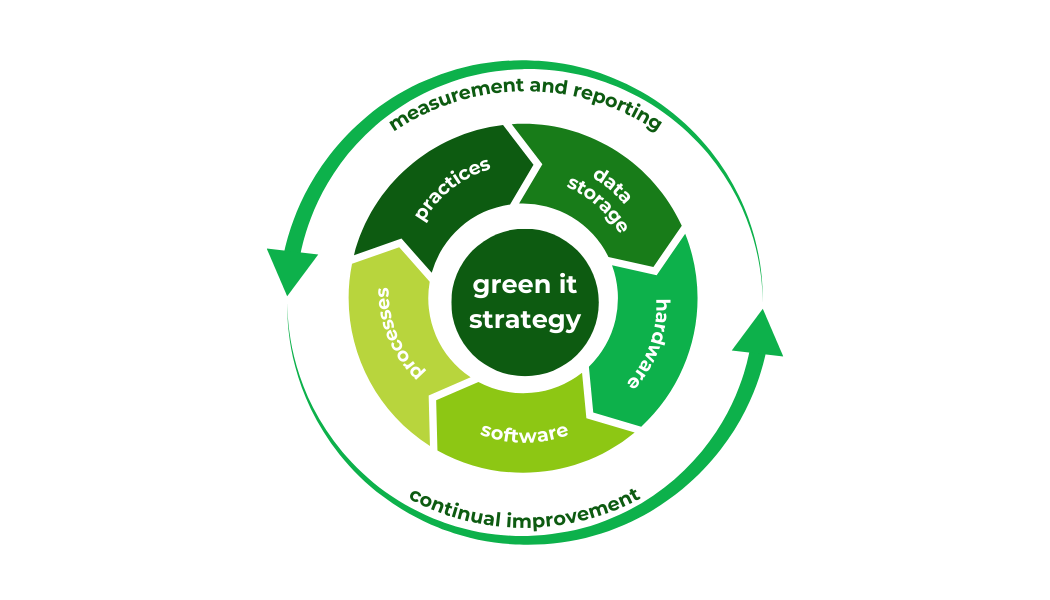
The Green IT Framework, developed by the Data Science Institute (DASCIN®), organizes sustainable IT practice into different components. Five are operational domains, the areas where environmental impact is generated. The remaining two are enabling disciplines that ensure the other five are measurable, governed, and improved over time. All 8 are anchored by an overarching Green IT Strategy.
From strategy to improvement
At its foundation sits the Green IT Strategy — the governance layer that sets sustainability goals, assigns accountability, and establishes the review cadence without which everything else remains aspiration. From that foundation, five operational domains address the areas where environmental impact is actually generated. Hardware covers the full physical lifecycle: embodied carbon incurred during manufacturing, energy consumed in operation, and the certified disposal of devices at end-of-life. Software recognizes that inefficient code makes hardware work harder — server virtualization, carbon-aware workload scheduling, and Software Carbon Intensity (SCI) measurement are the primary levers here. Processes govern the organizational behaviors that sit around technology: remote working policies, paperless workflows, renewable energy procurement through PPAs and RECs, and automated shutdown scheduling. Practices address culture and standards — employee awareness training, eco-design requirements embedded into procurement and development, and carbon offset programs for residual emissions that cannot yet be eliminated. Data Storage targets the energy and water footprint of storage infrastructure, focusing on Power Usage Effectiveness (PUE), Water Usage Effectiveness (WUE), and systematic management of redundant, obsolete, or trivial (ROT) data that accumulates at ongoing energy cost. The five operational domains are made meaningful by two enabling disciplines. Measurement and Reporting translates activity into evidence — using the GHG Protocol, GRI Standards, and the composite Green IT Impact Score (GIIS) to establish baselines, track progress, and report credibly to external stakeholders. Continual Improvement ensures the program keeps pace with a rapidly evolving technology and regulatory landscape, applying Plan–Do–Check–Act review cycles and horizon scanning so that what was fit for purpose in 2022 does not simply calcify by 2026.
Measurement and the Green IT Impact Score
The Measurement and Reporting component distinguishes a genuine Green IT program from a collection of ad hoc initiatives. Without a consistent measurement framework, organizations cannot establish reliable baselines, track progress meaningfully, or report credibly to external stakeholders.
The Green IT Impact Score (GIIS) is a composite metric that aggregates performance across all five operational domains into a single index. It is calculated from component-level formulae capturing embodied hardware carbon, server utilization waste, Software Carbon Intensity, business travel and paper emissions, idle device energy waste, data center carbon, and water usage. The GIIS enables performance comparison over time and identifies which domains contribute most to an organization’s overall footprint.
The reporting framework aligns with established international standards, the GHG Protocol Corporate Standard (the de facto foundation for all IT carbon measurement), GRI Standards 302, 305, and 306, ESRS E1 under the EU’s Corporate Sustainability Reporting Directive, and the Science Based Targets initiative (SBTi) for validated emissions reduction goals.
Key performance indicators for Green IT reporting
A well-designed Green IT KPI framework for external reporting typically covers six to ten metrics spanning all five operational domains, reported consistently year on year. Consistency matters: changing reported KPIs between periods, even for legitimate reasons, creates the impression of selective presentation and undermines stakeholder trust. If a KPI changes, the reasons should be explained and, where possible, the prior year figure restated on the new basis.
| Component | Indicator | Unit |
|---|---|---|
| Overall | Total IT-related greenhouse gas emissions | tCO₂e |
| Overall | Year-on-year emissions reduction | % |
| Hardware | Average device replacement cycle | Years |
| Hardware | E-waste directed to certified recycling | % of total |
| Software | Server / cloud utilisation rate | % |
| Software | IT infrastructure energy consumption | MWh |
| Processes | Renewable energy as % of IT electricity | % |
| Processes | Commuting emissions per IT employee | tCO₂e |
| Practices | Power management compliance rate | % |
| Practices | Green IT training completion rate | % |
| Data Storage | Data centre PUE | Ratio |
| Data Storage | Total data storage volume | TB |
Continual improvement and horizon scanning
A Green IT program is not a one-time project. The technology landscape, hardware efficiency, cloud platform capabilities, energy monitoring tools, and carbon accounting standards evolve rapidly. A program designed in 2022 and left unchanged is, by 2026, significantly out of date. Continual improvement mechanisms are what keep a program current.
The standard approach applies a Plan–Do–Check–Act (PDCA) cycle, structured as nested review mechanisms: an annual full audit, an annual strategy review, and quarterly operational reviews tracking progress against component-level targets. These are supplemented by stakeholder feedback loops and by horizon scanning, the systematic monitoring of external developments.
Technology horizon scanning covers processor efficiency improvements that alter hardware lifecycle calculations; advances in data center cooling, such as liquid cooling, direct chip cooling, and heat reuse; progress by cloud providers toward renewable energy commitments; and new carbon-intensity reporting APIs that improve the accuracy of cloud carbon accounting.
The regulatory landscape is equally dynamic. CSRD, SECR, SEC climate disclosure rules, updated certification standards, and evolving procurement requirements from enterprise customers all continuously change the environment in which a Green IT program operates.
The business case for Green IT
The environmental rationale for Green IT is straightforward. The financial case is increasingly compelling on its own terms, across four distinct categories.
Taken together, these four categories mean that Green IT investment is frequently attractive on financial grounds before any environmental value is considered. The question for most organisations is not whether to act, but where to begin.
Further learning
This article draws on Implementing Green IT: A Practitioner Guide published by DASCIN®. For professionals looking to develop a working, structured knowledge of these topics, including the Green IT Impact Score calculations, sustainability reporting frameworks, and practical implementation across all components. DASCIN® offers the:
Knowledge - Certification - Community