What is a Green IT Audit?
Definition A Green IT audit is a structured, evidence-based assessment of how well an organization's IT operations meet its sustainability goals. Using the DASCIN Green IT Framework, it reviews the Green IT strategy and the five operational domains (hardware, software, processes, practices and data storage), measures their environmental impact, and produces a prioritized [...]

Definition
A Green IT audit is a structured, evidence-based assessment of how well an organization’s IT operations meet its sustainability goals. Using the DASCIN Green IT Framework, it reviews the Green IT strategy and the five operational domains (hardware, software, processes, practices and data storage), measures their environmental impact, and produces a prioritized plan for improvement.
Also called: sustainable IT audit, Green IT assessment, IT sustainability review
Why Green IT audits matter
Green IT is the practice of implementing strategies that minimize the environmental impact of IT operations. In many organizations, IT is one of the largest contributors to the environmental footprint, through energy use, e-waste, water consumption and the resources needed to manufacture hardware.
The DASCIN Green IT Framework treats audits as the engine of continual improvement: regular audits and assessments show whether Green IT practices still work, measure progress, and verify compliance with sustainability standards. Without them, a Green IT strategy stays a statement of intent.
6%
Organizations with a highly mature sustainable IT strategy with clear goals and timelines (cited in the Green IT Framework)
47%
Share of digital device emissions from manufacturing, more than the use phase (cited in the Green IT Framework)
415TWh
Electricity used by data centers worldwide in 2024, projected to reach about 945 TWh by 2030 (IEA)
22.3%
Share of the 62 million tonnes of e-waste generated in 2022 that was formally recycled (UNITAR)
The Green IT Framework groups the business case into several opportunities, and an audit is how an organization proves them:
- Cost savings and efficiency. Lower energy use, consolidated infrastructure and longer hardware lifecycles reduce operating and capital costs.
- Compliance. Measured data prepares the organization for current and future environmental regulation.
- Reputation and competitive advantage. Verified results support credible sustainability claims to customers and investors.
- Innovation and growth. Audit findings point to where investment in green technology pays off.
The audit model: the DASCIN Green IT Framework
The DASCIN Green IT Framework, published as Green IT Framework: A Blueprint for Sustainable Enterprise IT, gives an audit its structure. Unlike general sustainability standards, it is built specifically for IT operations. It has three layers.
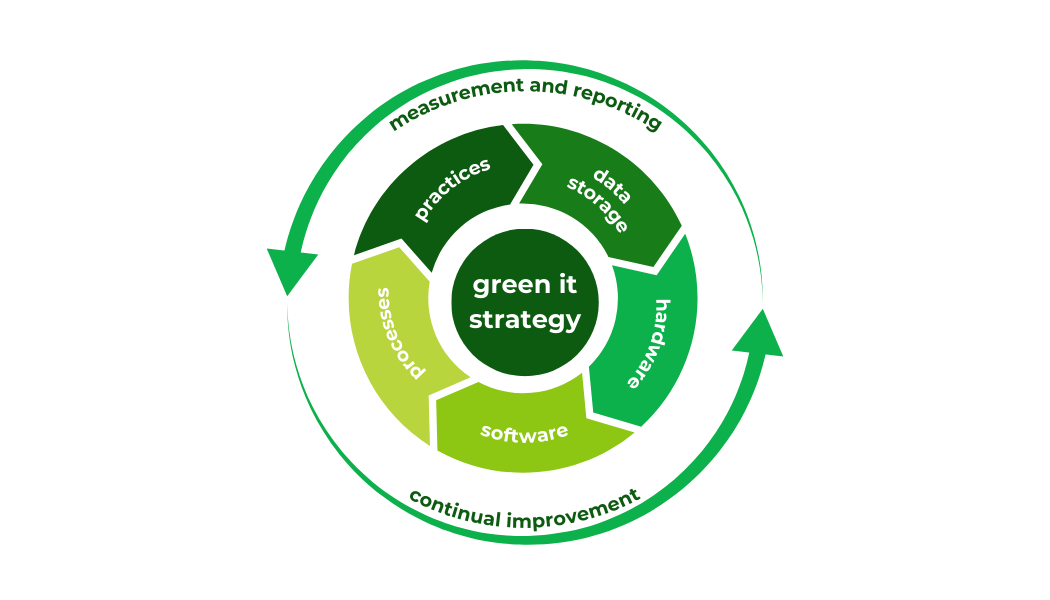
- Green IT strategy (core). Sustainability goals and objectives, Green IT governance, metrics and KPIs, stakeholder engagement, and investment in green innovation.
- Five domains. Hardware, software, processes, practices and data storage: the areas where the strategy turns into concrete actions.
- Two ongoing cycles. Measurement and reporting tracks progress; continual improvement reviews and refines it. The Green IT audit sits in these cycles.
The Green IT Framework, adapted from Figure 1 of the DASCIN publication.
What a Green IT audit covers
The framework’s action mapping lists the action areas for the strategy and each domain. An audit checks each area for evidence: does the organization have a policy, is it implemented, and is it measured? The table below doubles as an audit checklist.
| Framework element | Action areas reviewed | Typical audit questions |
|---|---|---|
| Green IT strategy | Sustainability goals and objectives; Green IT governance; metrics and KPIs; stakeholder engagement; investment in green innovation | Are goals specific and science based? Who owns Green IT? Which KPIs are tracked, and are employees, customers and suppliers involved? |
| Hardware | Energy-efficient hardware; product lifecycle management; hardware longevity and maintenance; supplier sustainability standards | Is certified efficient equipment preferred? How long are devices kept? What share of retired hardware is reused or recycled? Are suppliers assessed? |
| Software | Energy-efficient software development; virtualization and resource management; cloud computing; automated shutdown and scheduling | Is efficiency a design criterion? How well are servers virtualized and utilized? Do idle systems and devices shut down automatically? |
| Processes | Remote work policies; paperless office initiatives; renewable energy | How much commuting and printing does IT enable or require? What share of IT energy comes from renewable sources? |
| Practices | User awareness and training; eco-friendly design standards; carbon offset programs; reduced clock speed | Are staff trained? Do design standards include sustainability? Are offsets verified, and used only after reduction? |
| Data storage | Cloud versus on-premises; data lifecycle management; data compression and deduplication; green data center partnerships | Are retention rules enforced? How much redundant, obsolete or trivial data is stored? Do hosting partners use renewable energy and efficient cooling? |
Measurement tools used in a Green IT audit
The framework’s measuring and reporting cycle names five tools. An audit uses them to turn observations into numbers that can be compared over time.
| Tool | What it measures in an audit | Domains |
|---|---|---|
| Power Usage Effectiveness (PUE) | Energy efficiency of data centers: total facility energy compared with IT equipment energy | Data storage, hardware |
| GHG Protocol | Emissions in Scope 1 (direct), Scope 2 (purchased energy) and Scope 3 (supply chain, including purchased hardware and cloud) | All |
| GRI Standards | Structured disclosure on energy (302), emissions (305), waste (306), procurement (204) and supplier assessment (308) | Strategy, reporting |
| Life Cycle Assessment (LCA) | Impact of hardware and software across extraction, manufacturing, distribution, use and disposal | Hardware, software |
| ISO/IEC 30134 | Data center KPIs such as server energy efficiency (ITEE), renewable energy factor and energy reuse factor (ERF) | Data storage |
PUE
=
total facility energy
IT equipment energy
A PUE of 1.0 means all energy reaches the IT equipment. The framework notes that the average data center PUE was 1.67 in 2019: for every watt used for computing, another 0.67 watts went to cooling, lighting and other overhead. Software efficiency can also be scored with the Software Carbon Intensity specification, standardized as ISO/IEC 21031:2024.
How a Green IT audit works
- 1
Confirm the strategy and scope
Review sustainability goals, governance and existing KPIs. Agree which sites, systems, cloud services and device fleets are in scope, and the reporting period.
Framework: Green IT strategy
- 2
Build the baseline
Collect asset inventories, energy and cloud usage data, procurement records, retention policies and disposal records across all five domains.
Framework: five domains
- 3
Measure
Apply PUE, GHG Protocol scopes, LCA and ISO/IEC 30134 indicators. Document estimates where direct measurement is missing.
Framework: measurement and reporting
- 4
Assess against the action mapping
Check every action area for policy, implementation and evidence. Gather feedback from employees, stakeholders and partners through surveys or workshops.
Framework: action mapping, feedback mechanisms
- 5
Prioritize improvements
Rank opportunities by environmental impact, cost and effort, and translate them into SMART goals. Break large changes into smaller iterations.
Framework: SMART goals, agile methods
- 6
Report transparently
Share results with leadership and stakeholders using GHG Protocol and GRI structures, so progress can be compared and verified.
Framework: measurement and reporting
- 7
Review and repeat
Set a review cycle (quarterly, twice a year or annually), track KPIs in between, and re-audit to confirm results and refresh targets.
Framework: regular reviews and updates
How it relates to other standards
The Green IT Framework’s comparative review found that no existing framework focuses exclusively on IT, and none of those reviewed addresses software. Most center on reporting, management systems or target setting. An audit can still draw on them for the parts they cover.
| Framework or program | Focus | IT specific | Use in a Green IT audit |
|---|---|---|---|
| GRI Standards | Sustainability reporting | No | Structure for disclosing audit results on energy, emissions, waste and procurement |
| ISO 14001 | Environmental management systems and the Plan-Do-Check-Act cycle | No | Governance backbone; the audit supplies IT evidence for the “check” stage |
| LEED | Sustainable buildings | No | Criterion when selecting data center facilities and partners |
| ENERGY STAR | Energy performance of products and buildings | Partly | Benchmark for efficient hardware and data centers |
| SBTi Corporate Manual | Science-based emission targets | No | Reference for setting and validating IT reduction targets |
| ISO/IEC 30134 | Data center KPIs | Data centers | Source of standardized data center metrics |
| DASCIN Green IT Framework | Sustainable enterprise IT across strategy, hardware, software, processes, practices and data storage | Yes | The audit model itself |
Regulatory drivers in 2026
The Green IT Framework observes that the digital world has long been lightly regulated, leaving organizations to set their own standards. In the European Union, that is changing, and several rules now require data that a Green IT audit produces.
Data center reporting. Under the recast Energy Efficiency Directive and Commission Delegated Regulation (EU) 2024/1364, operators of data centers with installed IT power demand of at least 500 kW must report energy and sustainability indicators to a European database by 15 May each year.
Data center rating scheme. In September 2026, the European Commission proposed a rating scheme for data centers above 500 kW covering energy and water use and contributions to the grid, such as waste heat reuse. The first labels are expected in 2027.
Corporate sustainability reporting. Since the Omnibus I directive took effect on 18 March 2026, the Corporate Sustainability Reporting Directive applies to companies with more than 1,000 employees and more than €450 million in net turnover. Companies in scope need reliable IT emissions data, and they often ask their suppliers for it.
Outside the EU
Requirements differ by region, which the framework identifies as a challenge for global organizations. A single framework-based audit gives one consistent baseline that can be mapped to each jurisdiction’s rules.
Common challenges
The Green IT Framework identifies seven challenges that organizations face when implementing Green IT. Auditors meet the same issues, so it helps to plan for them.
Why it belongs in your enterprise data strategy
Data storage is one of the five domains of the Green IT Framework, and for good reason. Every stored dataset consumes energy and hardware for as long as it exists. The framework recommends clear retention policies, a routine schedule for archiving or deleting data that is no longer needed, storage tiers matched to how often data is used, and compression and deduplication to reduce volume.
These are also core data governance practices. Organizations that classify data, assign owners and enforce retention rules reduce their environmental footprint and their compliance risk at the same time. AI adds urgency: training and running models is compute intensive, so decisions about which data to keep and where to process it now carry environmental weight as well as cost.
Sources
- DASCIN (2025). Green IT Framework: A Blueprint for Sustainable Enterprise IT, version 1.2. The Data Science Institute. Primary source for the framework structure, action mapping, measurement tools, comparative review, challenges and cited statistics.
- International Energy Agency, Energy and AI: Executive Summary
- UNITAR, Global E-waste Monitor 2024
- DLA Piper, New data centre sustainability reporting obligations under Regulation (EU) 2024/1364
- European Commission, Making data centres energy efficient thanks to a new EU rating system (September 2026)
- CMS, Final adoption of Omnibus I Directive simplifying CSRD and CSDDD
- Greenhouse Gas Protocol
- GRI Standards
- ISO/IEC 21031:2024, Software Carbon Intensity specification
- ISO/IEC 30134 series, Data centres: key performance indicators
This entry is for general information and is not legal advice. Regulatory details reflect published sources as of October 2026.
Knowledge - Certification - Community