Automation Maturity Model
A structured framework for assessing where your organization stands on the automation journey and a clear roadmap to reach the next level.

Every organization sits somewhere on the automation spectrum — from manually intensive processes carried out by people at every step, to fully autonomous, AI-orchestrated workflows that self-heal and continuously optimize. The Automation Maturity Model gives you a vocabulary and a diagnostic lens to pinpoint that position, understand the gaps, and build a credible case for investment in the next stage of capability.
“Maturity is not about the number of bots deployed. It’s about the organizational capability to govern, scale, and extract sustained value from automation; reliably, repeatedly, and at speed.”
Why Maturity Models Matter
Robotic Process Automation (RPA) and broader Service Automation initiatives frequently stall not because the technology fails, but because organizations underestimate the people, process, and governance dimensions required to scale. A maturity model surfaces these blind spots. It helps executives benchmark their program against industry peers, identify which capability gaps are blocking ROI, and prioritize where to invest next.
At DASCIN, we use a six-level model adapted from established capability frameworks, ranging from no automation capability at Level 0 to an autonomous, AI-driven enterprise at Level 5. Each level has distinct characteristics across four core dimensions: Technology, Process, People & Governance, and Value Realization.
The Six Maturity Levels
Each level below represents a meaningful leap in organizational capability — not just a technology upgrade. Progression requires parallel advancement across all four dimensions.
L0 : No Automation — Manual Operations
Awareness stage · Ad hoc processes
All business processes are executed manually by human workers. There is no structured awareness of the potential for automation, no dedicated tooling, and no internal skills in RPA or service automation. Processes are largely undocumented and vary from individual to individual. Errors and rework are accepted as routine. The cost of manual operations is not actively measured.
L1 : Piloting — Proof of Concept
Exploration stage · Isolated experiments
The organization has identified RPA or automation as a strategic opportunity and has launched one or more proof-of-concept pilots. Bots are built by a small team targeting the highest-visibility, lowest-complexity processes. There is no formal governance structure, pipeline management, or CoE. Success is measured informally. Technology platforms are being evaluated.
L2 : Established — Repeatable Delivery
Foundation stage · Structured deployment
Automation delivery has moved beyond one-off pilots. A Center of Excellence (CoE) is being stood up or is newly operational. A defined process for identifying, prioritizing, and delivering automations is in place. A library of reusable components exists. Basic governance — change management, bot ownership, incident response — is formalized. KPIs are tracked: FTE savings, cycle time reduction, error rate improvement. Teams are trained on an approved RPA platform.
L3 : Scaled — Enterprise Rollout
Scale stage · Multi-function adoption
Automation is no longer confined to one department. Multiple business units actively consume automation services from the CoE. A mature pipeline process — from opportunity intake through business case, development, UAT, and deployment — operates at speed. An Orchestrator platform manages a fleet of attended and unattended bots. Business stakeholders participate in process identification. An executive sponsor actively champions the program. A citizen developer program may be emerging.
L4 : Optimized — Intelligent Automation
Intelligence stage · Cognitive & AI-augmented
RPA is augmented with AI and machine learning capabilities: document intelligence (IDP), natural language processing, predictive analytics, and computer vision. The automation program integrates with broader digital transformation initiatives. Process mining tools are used to discover automation candidates at scale. The CoE has shifted from a delivery team to a product team. Benefits realization is tracked in a real-time dashboard visible to leadership.
L5 : Autonomous — Self-Optimizing Enterprise
Mastery stage · AI-orchestrated & continuous
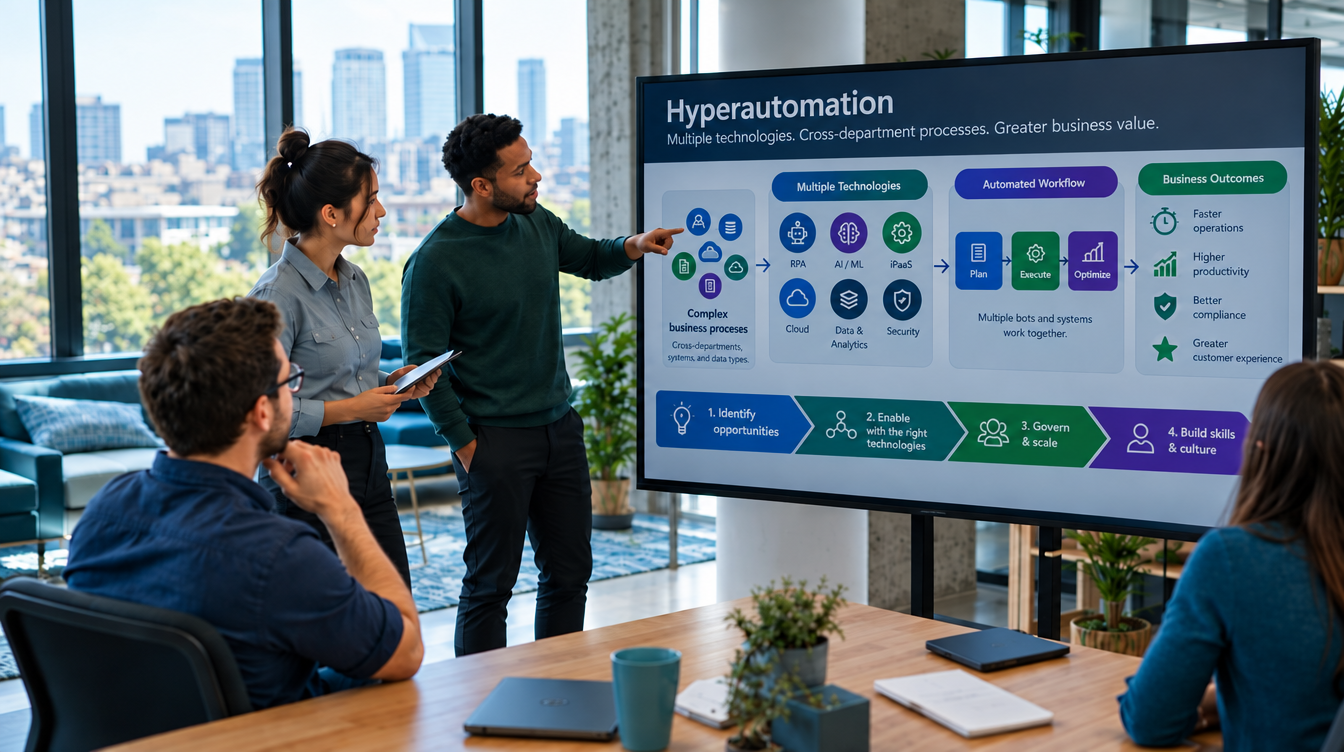
The organization operates as an automation-first enterprise. Hyperautomation — the combination of RPA, AI, process mining, analytics, and low-code platforms — is embedded into the enterprise architecture. Bots self-monitor and trigger escalation without human intervention. Agentic AI workflows handle complex, decision-intensive tasks. Continuous improvement loops feed performance data back into process redesign automatically.
The Four Assessment Dimensions
To accurately place your organization on the maturity scale, each of the four dimensions below must be assessed independently. An organization may be Level 3 in Technology but only Level 1 in Governance — a common pattern that explains why many scaled RPA programs hit unexpected operational crises.
| Dimension | What It Measures | Key Indicators |
|---|---|---|
| Technology | Platform capability, integration depth, and tool coverage | RPA platform selection; Orchestrator; AI/IDP tooling; process mining; API connectivity; security posture |
| Process | Standardization, documentation, and suitability for automation | Process documentation quality; exception rate; data input consistency; digital input availability; process stability |
| People & Governance | Skills, sponsorship, CoE structure, and risk management | CoE existence and staffing; executive sponsorship; developer pipeline; citizen developer program; change management capability |
| Value Realization | Business benefits captured, measured, and reported | FTE savings tracked; ROI measured; benefits realized vs. forecast; leadership visibility; reinvestment into automation pipeline |
Process Selection: What Makes a Good Automation Candidate?
A common mistake at Level 1 and Level 2 is selecting the wrong processes for automation, choosing high-complexity, high-exception, or politically sensitive processes that are difficult to automate reliably. The most successful programs focus first on processes that score well across the following criteria:
DASCIN Tip
Use a weighted scoring matrix to rank automation candidates. Score each candidate on volume, complexity, stability, strategic value, and expected FTE savings. This creates an objective, defensible pipeline that builds organizational confidence in the program.
The Automation Center of Excellence (CoE)
The CoE is the organizational engine of any scaled automation program. It is the difference between a collection of bots and a managed automation capability. The CoE model evolves significantly across maturity levels.
From RPA to Intelligent Automation
Traditional RPA automates rule-based tasks by replicating human interaction with digital interfaces. As organizations progress through maturity Levels 3 to 5, RPA is enhanced with intelligent capabilities that extend automation into previously off-limits territory:
Advancing Through Maturity: A Practical Roadmap
Moving up the maturity curve requires deliberate investment in capability — not just more bots. Below is a phased approach most organizations use to progress from Level 1 through to Level 4.
- 1
Secure Executive Sponsorship
Identify a C-suite champion — COO, CIO, or CFO — who has a genuine stake in operational efficiency. Automation programs without visible leadership sponsorship stall at Level 1. The sponsor should champion the program in leadership meetings, remove organizational blockers, and ensure business units cooperate with process discovery and pilot deployment.
- 2
Build the Business Case with Real Data
Use time-and-motion studies, system logs, and interview data to quantify the current cost of manual processes. Build a financial model that captures FTE savings, error reduction, cycle time improvement, and compliance benefits. Include a realistic implementation cost and payback period. A credible business case protects the program during budget cycles.
- 3
Select and Standardize Your Platform
Choose a single RPA platform for your initial rollout — fragmented multi-platform environments dramatically increase governance and maintenance overhead. Evaluate leading platforms (UiPath, Automation Anywhere, Microsoft Power Automate) against your technology landscape, IT security requirements, and skill availability in your talent market. Establish development standards, version control, and a reusable component library before scaling.
- 4
Stand Up the CoE and Formalize Governance
Establish the CoE structure, define its operating model (federated, centralized, or hybrid), and document the end-to-end delivery process — from intake form to production deployment. Define bot ownership, change management procedures, incident escalation paths, and audit requirements. Implement the Orchestrator for centralized bot management and performance monitoring.
- 5
Scale Across Business Units with a Managed Pipeline
Run structured process discovery workshops across Finance, HR, Operations, IT, and customer-facing functions. Score and prioritize candidates using your weighted matrix. Establish a quarterly pipeline review with business stakeholders. Track pipeline health metrics: candidates identified, in development, in UAT, in production, and retired. Begin a citizen developer enablement program to extend the reach of automation into the business.
- 6
Introduce Intelligent Capabilities
Integrate IDP for document-heavy processes. Add NLP for email triage and customer query routing. Pilot process mining tools to discover automation opportunities at scale. Evaluate AI platforms that integrate natively with your RPA stack. Establish an AI governance policy covering model bias, data privacy, and explainability requirements. Build the MLOps capability to maintain and retrain models in production.
Common Failure Modes by Maturity Level
Understanding where programs typically fail helps you take pre-emptive action. These patterns appear consistently across industries:
Measuring Automation Value
At every maturity level, value measurement should be systematic, not anecdotal. The following metrics form a balanced scorecard for an automation program:
| Metric Category | Example KPIs | Relevant From |
|---|---|---|
| Efficiency | FTE hours saved; process cycle time reduction; cost per transaction | Level 2 |
| Quality | Error rate reduction; rework volume; SLA compliance rate | Level 2 |
| Scale | Bots in production; processes automated; departments covered; pipeline size | Level 3 |
| Financial | ROI %; NPV of automation portfolio; cost avoidance; payback period | Level 2 |
| Resilience | Bot uptime %; mean time to recovery; incident rate; exception handling rate | Level 3 |
| Strategic | Employee experience score; customer satisfaction; regulatory compliance improvement | Level 4 |
Self-Assessment: Where Is Your Organization?
Use the following questions to guide an honest assessment of your current automation maturity. For each question, consider which maturity level best describes your current state across all four dimensions.
Diagnostic Questions
- Do you have a formal process for identifying and prioritizing automation opportunities?
- Is there a named executive sponsor actively supporting the automation program?
- Does a Center of Excellence (or equivalent) exist with dedicated staff?
- Are your deployed bots centrally managed via an Orchestrator platform?
- Do you track FTE savings and ROI in a dashboard visible to leadership?
- Have you deployed automation across more than two business functions?
- Do you have a citizen developer program enabling non-technical staff to build automations?
- Have you integrated AI capabilities (IDP, NLP, or ML) into any automation workflows?
- Is process mining used to discover and quantify automation opportunities at scale?
- Do your bots self-monitor, alert, and escalate without human intervention?
Knowledge - Certification - Community