
What Is Hyperautomation? Definition, Examples, and How It Works
What is hyperautomation? Learn how it differs from traditional automation, see real examples and technologies, and find out how to build the skills behind it.
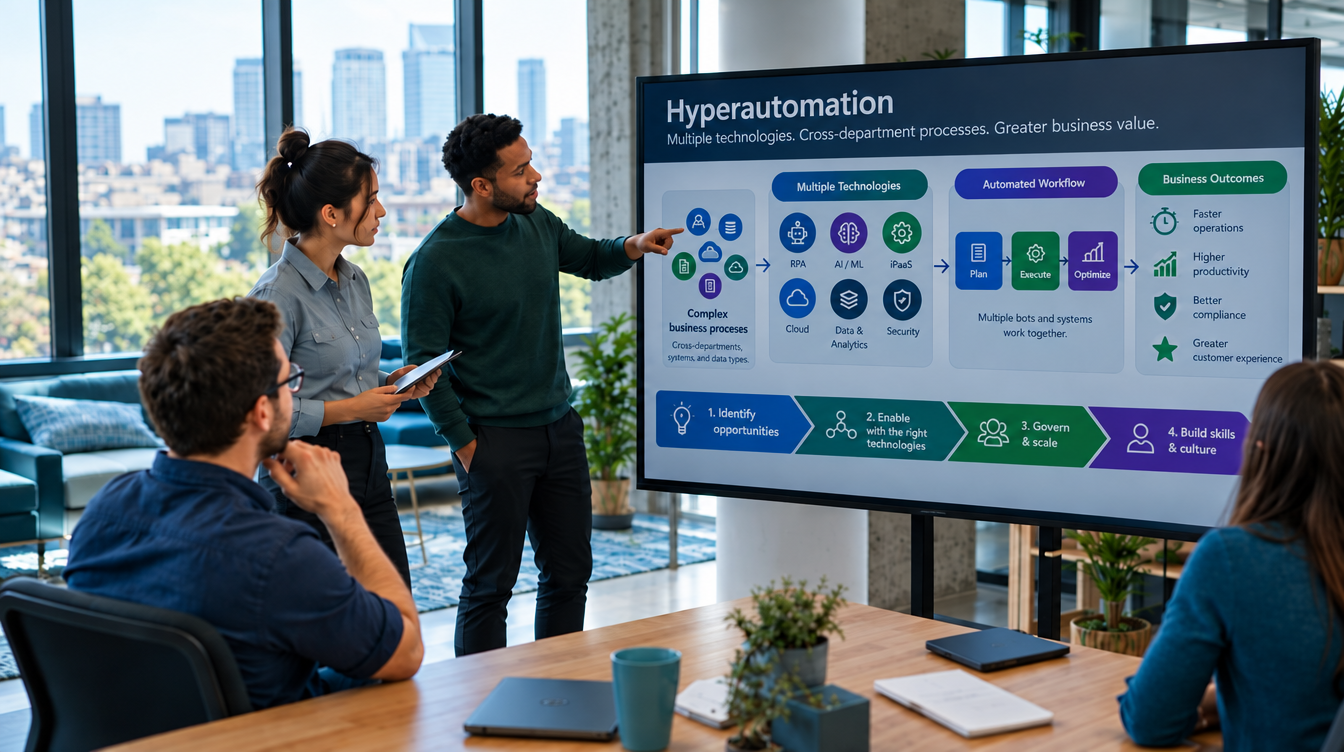
Hyperautomation is the discipline of automating as many business and IT processes as possible by combining several technologies, rather than relying on a single tool. Most organizations have already automated their easiest tasks. The next gains sit in workflows that cross departments, systems, and data types, where a single bot cannot reach on its own. This guide explains what hyperautomation is, how it differs from traditional automation, which technologies and examples define it, and how teams can implement it with the right governance and skills.
Key takeaways
- Hyperautomation is a business-driven approach for finding, vetting, and automating as many processes as possible, a concept introduced by Gartner.
- It combines RPA, AI and machine learning, process mining, low-code platforms, and orchestration instead of relying on one tool.
- Successful programs start with process discovery and redesign, not with tool selection.
- Gartner forecasts the market for hyperautomation-enabling software will reach $1.07 trillion by 2028.
- A Center of Excellence, clear governance, and certified skills separate scaled programs from isolated pilots.
What Is Hyperautomation?
Gartner introduced the term and ranked hyperautomation first in its Top 10 Strategic Technology Trends for 2020. Its glossary defines hyperautomation as a disciplined, business-led approach to rapidly identifying, vetting, and automating as many business and IT processes as possible (Gartner).
The defining idea is orchestration. Gartner lists the ingredients as artificial intelligence and machine learning, event-driven software architecture, robotic process automation (RPA), business process management suites, integration platforms, low-code and no-code tools, packaged software, and other decision and task automation tools. No single product delivers hyperautomation. It emerges when these tools work together inside one governed approach.
In plain terms, traditional automation asks, “Which task can we automate?” Hyperautomation asks, “How does this work actually flow from start to finish, and which combination of tools removes manual effort from all of it?”
Hyperautomation vs Traditional Automation
The difference between hyperautomation and traditional automation is one of the most searched questions on the topic. The table below summarizes it.
| Dimension | Traditional automation | Hyperautomation |
|---|---|---|
| Scope | A single task in one system | Complete processes across departments and systems |
| Starting point | A tool looking for a use case | A mapped process looking for the right mix of tools |
| Data | Mostly structured | Structured and unstructured (documents, emails, images) |
| Decisions | Fixed rules | Rules plus AI-assisted judgment within guardrails |
| Lifecycle | One-time project | Continuous discovery, measurement, and improvement |
| Governance | Owned by one team | Coordinated through a Center of Excellence |
Traditional automation is not obsolete. RPA remains the workhorse inside most hyperautomation programs (see Robotic Process Automation Explained). The difference is that hyperautomation treats RPA as one instrument in an orchestra rather than the whole performance.
The Hyperautomation Technology Stack
Hyperautomation technologies fall into seven layers. Most programs use several of them together.
Gartner describes tools such as RPA, low-code platforms, and AI as process-agnostic, meaning organizations can apply them across many different use cases (Gartner, 2021). That flexibility is why they sit at the center of most programs.
Hyperautomation Examples by Industry
Real hyperautomation examples share one pattern: several technologies hand work to each other so that a person only steps in for genuine exceptions.
| Industry | Process | How the stack works together |
|---|---|---|
| Banking | Loan applications | Document AI extracts data from forms and pay stubs, a model scores risk, and RPA updates the core banking system. |
| Insurance | Claims intake | Language models triage incoming emails, document AI reads claim forms, a fraud model flags outliers, and simple claims settle without manual touch. |
| Healthcare | Patient intake and billing | Bots verify insurance eligibility, populate records, and prepare claims, while staff handle clinical exceptions. |
| IT operations | Incident response | Monitoring detects a spike in failed transactions, analytics link it to a recent release, automation rolls the change back, and a ticket opens with full context. |
| Human resources | Employee onboarding | One trigger creates the HR record, provisions accounts and equipment, enrolls payroll, and schedules training. |
| Procurement | Invoice matching | Document AI reads invoices, rules perform a three-way match against orders and receipts, and only mismatches reach a person. |
Which Processes Should You Automate First?
Not every process is a good candidate. A useful screening test looks for “swivel chair” work, where a person copies information from one screen into another. Strong early candidates share five traits:
- 1
Rule-based. Clear logic decides every step.
- 2Structured data. Inputs arrive in predictable formats.
- 3High volume. The work repeats often enough to justify the build.
- 4Repetitive. The same steps recur with little variation.
- 5Stable and deterministic. The same inputs reliably produce the same outputs, and the process rarely changes.
Processes that depend on judgment, generate frequent exceptions, or change shape often are usually poor early candidates. So are processes with poor data quality. Automating a broken process only makes it fail faster. To see where your organization stands before scaling, the Automation Maturity Model offers a useful benchmark.
How to Implement Hyperautomation in Five Steps
Most successful hyperautomation programs follow a similar sequence. The order matters more than the tools.
- 1
Discover. Use process mining and interviews to map how work actually flows today. This reveals bottlenecks, rework, and deviations before anything is built.
- 2
Prioritize. Score candidates on volume, value, complexity, and risk, then build a business case for the top few.
- 3
Redesign before you automate. Gartner once predicted that organizations would lower operational costs by 30% by combining hyperautomation technologies with redesigned operational processes (Gartner, 2021). The lasting lesson is the second half of that sentence: redesign is half of the value.
- 4
Build and orchestrate under governance. Most organizations coordinate this through a Center of Excellence that owns standards, tool selection, reusable components, and risk controls. Common models are centralized, federated, and hybrid. The Service Automation Framework provides a vendor-neutral structure for this work, and our guide to designing a Center of Excellence covers the operating model in more depth.
- 5
Measure and improve. Track cycle time, error rate, straight-through processing rate, hours returned to the business, and bot utilization. Feed the results back into discovery so the pipeline of opportunities keeps moving.
The limiting factor in most programs is rarely the technology. It is change management: making sure the people whose work is changing understand, trust, and adopt the new process instead of working around it.
Hyperautomation and Agentic AI in 2026
AI agents are software systems that can take a goal, access the data and applications they need, and complete tasks with minimal human intervention. They extend hyperautomation from following scripts to making bounded decisions.
Gartner predicts that at least 15% of day-to-day work decisions will be made autonomously through agentic AI by 2028, up from 0% in 2024, and that 33% of enterprise software applications will include agentic AI by 2028 (Gartner, 2025). The same research warns that more than 40% of agentic AI projects will be canceled by the end of 2027 because of escalating costs, unclear business value, or inadequate risk controls.
Gartner’s practical advice maps neatly onto the hyperautomation stack: use agents where decisions are needed, automation for routine workflows, and assistants for simple retrieval. In other words, agentic AI makes hyperautomation discipline more important, not less. Process discovery, orchestration, governance, and measurement are exactly what keep agent projects out of the canceled column. For the governance side, see AI and Data Governance: What Businesses Need to Know.
Why Hyperautomation Matters Now
Analyst forecasts show how central hyperautomation has become to enterprise technology strategy. Gartner forecasts that the market for software that enables hyperautomation will reach $1.07 trillion by 2028, growing at a compound annual rate of 13.9% (Gartner). A separate Gartner analysis puts the process-agnostic segment (tools such as RPA, low-code platforms, and conversational AI) at $119.2 billion by 2028, growing 15.9% a year, with IoT platforms and conversational AI among the strongest growth areas (Gartner).
For organizations, the practical benefits of hyperautomation include:
- Faster cycle times, because handoffs between systems and teams disappear.
- Fewer errors, because bots do not mistype or skip steps.
- Better use of skilled people, who move from data entry to analysis, service, and improvement work.
- Stronger compliance, because every automated step is logged and auditable.
- Operational agility, because orchestrated processes can be reconfigured when regulations, markets, or customer needs shift.
Common Hyperautomation Pitfalls
Even well-funded programs stall for predictable reasons:
Building Hyperautomation Skills with DASCIN
RPA is the technology most hyperautomation programs build on first, which makes it the natural starting point for skills. DASCIN’s RPA Foundation is a vendor-neutral credential aligned with the Service Automation Framework and examined by APMG International. It requires no prior technical experience.
The program covers the business drivers of RPA, platform architecture (robots, the designer or studio, and the orchestrator), selecting suitable processes, structuring workflows, common automation functions, monitoring and exception handling, automation orchestration, and how to set up RPA projects and a Center of Excellence. The exam has 40 multiple-choice questions, runs 60 minutes, and requires a score of 65% to pass.
From there, professionals can progress to RPA Practitioner for advanced techniques, or broaden into service design and governance with Service Automation Foundation. Organizations training whole teams can use the Enterprise Learning Portal.
Take the next step
Start with RPA Foundation

Knowledge - Certification - Community


