The 2026 Tech Job Market Explained: What the Layoffs and the Skills Data Both Show
A look at 2026 hiring and layoff data from IDC, Gartner, the World Economic Forum, Challenger, Gray & Christmas, Reuters and LinkedIn, and the DASCIN certifications aligned with continuing demand through 2027.

The organization featured in this case study asked not to be named, and identifying details (sector sub-segment, office locations, vendor names) have been generalized at its request. The initiatives, sequencing, and overall 17% result reflect its actual Green IT programme as reported to its steering committee.
139,156
Announced technology sector job cuts, H1 2026
(Challenger, Gray & Christmas)
+113%
Projected growth in Big Data Specialist roles to 2030
(World Economic Forum)
60%
Governance teams prioritising unstructured data by 2027
(Gartner)
The technology labour market in 2026 shows two clear patterns unfolding at the same time. Research from IDC, Gartner and the World Economic Forum points to sustained, structural demand for data, AI, governance and sustainability skills extending through 2027 and beyond. Alongside that, 2026 has also recorded some of the heaviest technology sector job losses in recent years. Challenger, Gray & Christmas, the outplacement firm whose monthly job-cut report is the most widely cited hard figure in financial journalism, recorded 139,156 announced technology sector cuts through the first half of 2026, an increase of 83% on the same period in 2025, with artificial intelligence cited as a factor in approximately 23% of all job cuts announced across every sector this year. Understanding the labour market in 2026 means accounting for both patterns together, rather than reading one as having overtaken the other.
2026 Layoff Data
Technology Sector Job Cuts: 2025 vs 2026
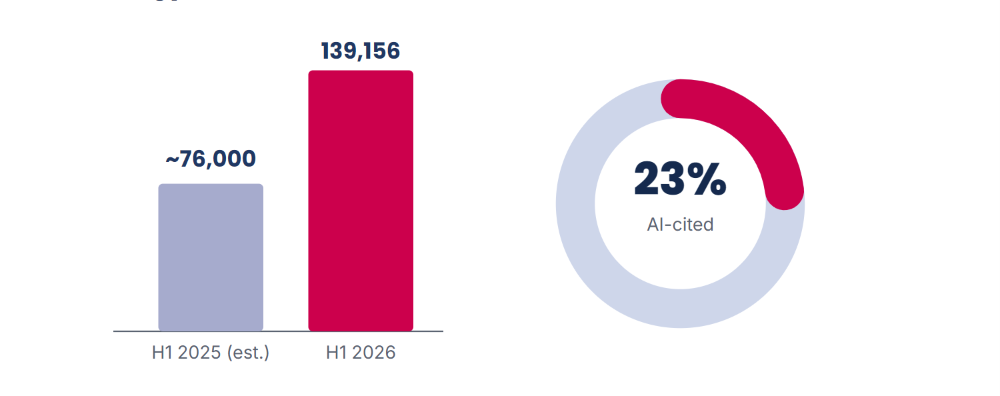
Source: Challenger, Gray & Christmas, Job Cut Report, H1 2026. The H1 2025 figure is derived from the reported 83% year-on-year increase.
The explanation is not that the growth forecasts were wrong. It is that they were never forecasts of total headcount. They were forecasts of which skills would be in demand relative to others, and the 2026 cuts are consistent with that distinction rather than contradicting it. Reuters coverage of individual companies, together with TechCrunch’s ongoing tracker of AI-linked layoffs, points to a consistent pattern often described as “cut and redirect”: employers are reducing generalist, junior and legacy-skill positions, including within software engineering itself, while opening new roles in AI-native engineering, machine learning operations and specialised technical functions in the same announcement. Atlassian, for instance, cut around 1,600 positions in March 2026 concentrated in content, customer support, quality assurance and project management, while simultaneously opening roughly 800 new roles in AI engineering and machine learning operations.
LinkedIn’s own Economic Graph research, drawn from real-time platform data rather than announced plans, adds a further data point worth taking seriously: it finds that hiring softness is concentrated in advanced economies and driven mainly by economic uncertainty and monetary policy rather than by AI exposure specifically, and that AI has simultaneously added an estimated 1.3 million new roles globally, including more than 600,000 AI-enabled data centre jobs.
LinkedIn Economic Graph, January 2026
Where the New AI-Linked Roles Are Landing
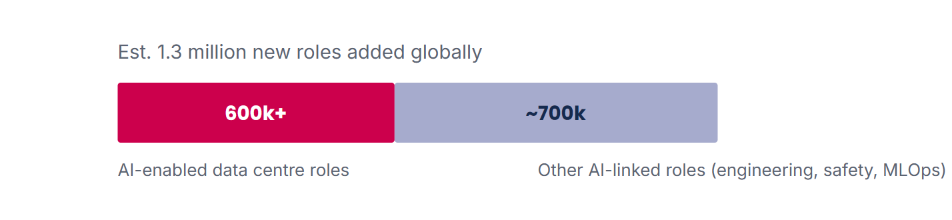
Source: LinkedIn Economic Graph, Labor Market Report, January 2026.
Read together, these sources point to the same underlying pattern. The roles named in the growth research, including data governance, AI oversight, data engineering and sustainability reporting, are largely the roles organisations are hiring into as they restructure, rather than the roles being removed.
A Market Bifurcating, Not Simply Shrinking
This distinction matters more than any single statistic. IDC’s widely cited estimate that unresolved skills shortages could cost the global economy up to $5.5 trillion by 2026 remains the reference figure most of the industry uses for the scale of the shortfall in IT operations, cloud architecture, data management and software development. The two developments reinforce rather than cancel each other. Employers cutting broad-based technical headcount while simultaneously reporting record revenue, as Cisco and Oracle both did this year, are not describing a shrinking need for technical capability. They are describing a narrower, more specific one.
“The market is not short of technology workers in aggregate. It is short of workers who can be verified as holding the specific skills a restructured, AI-enabled organisation now needs.”
The Roles Still Named in the Growth Data
The World Economic Forum’s Future of Jobs Report 2025, based on a survey of more than 1,000 employers representing over 14 million workers, is the current edition of the Forum’s biennial series, published in January 2025, with the next edition due in January 2027. It remains the primary source on where growth is concentrated through 2030. Technology roles dominate the list in percentage terms, and 90% of employers surveyed expect rising demand for AI and big data skills specifically, extending well beyond technical teams into finance, HR, marketing and operations.
World Economic Forum, Future of Jobs Report 2025
Projected Role Growth to 2030
Big Data Specialists
AI & Machine Learning Specialists
Data Warehousing Specialists
Data Analysts and Scientists
Environmental Protection Professionals
Sustainability Specialists
Source: World Economic Forum, Future of Jobs Report 2025 (published January 2025).
Table 1 — Fastest-Growing Roles Through 2030 and Closest DASCIN Starting Point
| Role | Projected growth to 2030 | Source | Closest DASCIN starting point |
|---|---|---|---|
| Big Data Specialists | +113% | WEF, 2025 | EBDP® → EBDA® / EBDE® |
| AI and Machine Learning Specialists | +82% | WEF, 2025 | AIPR® |
| Data Warehousing Specialists | +49% | WEF, 2025 | EBDE® / EBDAR® |
| Data Analysts and Scientists | +41% | WEF, 2025 | EBDA® / EBDS® |
| Environmental Protection Professionals | +34% | WEF, 2025 | GITA® → GITF® |
| Sustainability Specialists | +33% | WEF, 2025 | GITA® → GITF® |
It is worth reading this table alongside the layoffs, not instead of them. None of the roles listed above match the categories cited most often in 2026 redundancy announcements. That gap between what is being cut and what is being grown is itself the clearest evidence that this remains a market worth certifying into, provided the certification is aimed precisely at the roles still in demand rather than at general technical literacy alone.
Governance Moves From Back Office to Boardroom
Gartner’s data and analytics predictions for 2026 describe governance as the function under the most acute talent pressure, and nothing in this year’s layoff data has altered that assessment. By 2027, Gartner expects 60% of data governance teams to prioritise governing unstructured data specifically to support generative AI use cases, a shift from governing rows and columns to governing documents, transcripts and model outputs. At the same time, Gartner predicts that 80% of data and analytics governance initiatives will fail by 2027 without a clear business trigger, and its Peer Community research places talent and expertise shortages at the top of the reasons why.
Gartner, Data & Analytics Predictions 2026
Governance Under Pressure
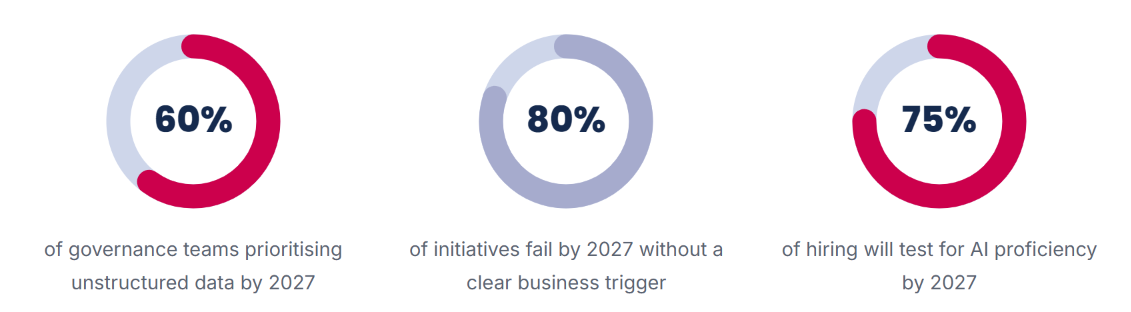
Source: Gartner, Data & Analytics Predictions 2026 (published March 2026); Gartner Peer Community research.
That combination of rising scope, a high failure rate and an acute talent shortage is precisely the profile of a function where certified skills carry outsized weight. Current market data for data governance and GRC roles shows average salaries in the region of $99,000 to $120,000, with senior governance positions in financial centres clearing $160,000. Separately, Gartner forecasts that by 2027, 75% of hiring processes will include some form of certification or testing for workplace AI proficiency. Formal verification is becoming a recruiting default rather than a discretionary extra, which is a meaningful advantage for candidates who already hold one.
Market Salary Data, 2026
Data Governance & GRC Salary Bands (USD)
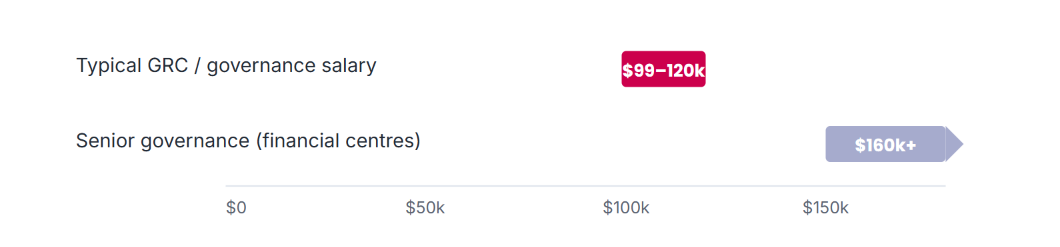
Source: Current market salary aggregators for data governance and GRC roles, 2026.
Green IT Stops Being a Niche Specialism
Sustainability hiring is growing on its own terms and converging with the data and AI trend at the same time. The World Economic Forum projects sustainability specialists to grow by roughly a third and environmental protection professionals by slightly more, together accounting for close to a million jobs in the report’s framing. The technology sector already holds a meaningful share of the wider green economy, and that overlap is deepening. The scale of AI infrastructure is now a direct driver of demand for data centre energy efficiency, green computing strategy and sustainable procurement roles, rather than a side effect of it.
The International Energy Agency’s analysis of online job postings in clean energy and digital energy fields reinforces the same point from the labour market side. Technician, associate professional and skilled trades roles are the most frequently advertised categories, meaning this demand sits squarely at working professional level rather than being confined to specialist engineers. For anyone in procurement, facilities or IT operations being asked to factor sustainability into decisions for the first time, this is a market that rewards getting the vocabulary right early.
What This Means for Where You Start
None of this changes how DASCIN® certifications are structured. There are still no prerequisites, and the Foundation, Practitioner and Specialist tiers still exist to match a certification to current readiness rather than an eventual goal, as set out in the DASCIN Certification Roadmap. What the 2026 data adds is a sharper, more cautious steer on which subject area to prioritise first, based on where hiring pressure is most acute right now rather than where it was twelve months ago.
Table 2 — Matching the Market Signal to a Starting Certification
| What the market is telling you | Where to start |
|---|---|
| Your role touches data but you don’t yet build or manage it | Data Literacy Fundamentals (DLFU®) or Enterprise Big Data Professional (EBDP®) |
| You lead, scope or govern AI adoption rather than build models | AI Practitioner (AIPR®) |
| You’re responsible for data quality, stewardship or compliance | Data Governance Fundamentals (DGFU®) and Data Management Fundamentals (DMFU®) |
| Sustainability decisions are landing on your desk for the first time | Green IT Awareness (GITA®) |
| You already own IT procurement or infrastructure decisions | Green IT Foundation (GITF®) |
| You’re scoping or delivering automation programmes | Service Automation Foundation (SAFF®) or RPA Foundation (RPAF®) |
Where a role spans more than one of these areas, such as governance and AI, or automation and RPA, holding more than one certification is common, and, based on where the market is heading, increasingly expected rather than exceptional.
In Summary
The data reviewed here comes from different sources measuring different things: announced layoffs, projected skills gaps, and longer-term role growth. Taken together, they describe a labour market that is contracting in scale for some categories of technical role while continuing to build demand for others. Data, AI, governance and sustainability roles remain the categories organisations are hiring into even as they reduce headcount elsewhere, and employers are formalising how they screen for the skills involved. DASCIN® certifications carry no expiry date and no periodic resitting requirement, which means the time invested now against today’s hiring pressure continues to hold its value as the market moves through 2027 and beyond.
References
- Challenger, Gray & Christmas. (2026). Job Cut Report, H1 2026.
- Gartner. (2026). Data and Analytics Predictions 2026. Retrieved from https://www.gartner.com
- IDC. (2024). Worldwide IT skills gap forecast. Retrieved from https://www.idc.com
- International Energy Agency. (2026). Clean energy employment and digital energy job postings analysis. Retrieved from https://www.iea.org
- LinkedIn Economic Graph. (2026). Labor Market Report, January 2026. Retrieved from https://economicgraph.linkedin.com
- Reuters. (2026). Coverage of technology sector workforce restructuring, 2026. Retrieved from https://www.reuters.com
- TechCrunch. (2026). The running list: major tech layoffs in 2026 that have name-checked AI. Retrieved from https://techcrunch.com
- World Economic Forum. (2025). Future of Jobs Report 2025. Retrieved from https://www.weforum.org
Knowledge - Certification - Community