What is AI Ethics?
The values and principles that guide how artificial intelligence is designed, built, deployed and governed, so that it benefits people and avoids harm.

Definition
AI ethics is the field that studies and sets out the moral principles for artificial intelligence across its whole lifecycle: research, design, data collection, development, deployment, use and retirement. It asks what AI systems should and should not do, who is accountable when they cause harm, and how their benefits and risks are shared across society. In organizations, AI ethics is turned into practice through policies, risk assessments, oversight roles and technical controls.
Related terms: responsible AI, trustworthy AI, AI governance, algorithmic fairness, human-centered AI
Why AI ethics matters
AI systems now help decide who gets a job interview, a loan, a medical referral or extra scrutiny from the state. They do this at a scale and speed no human team can match, which means a single flawed design choice can affect millions of people before anyone notices. Unlike a human decision maker, a model cannot explain itself unless it was built to, and it can repeat the same mistake consistently.
The evidence suggests that responsible practice is not keeping pace with adoption. Stanford’s 2026 AI Index reports that responsible AI benchmarking is growing, but more slowly than AI capability and deployment.
362
AI incidents recorded by the AI Incident Database in 2025, up from 233 in 2024 (Stanford AI Index 2026)
11%
Share of businesses with no responsible AI policies, down sharply from 24% (Stanford AI Index 2026)
193
UNESCO Member States that adopted the first global standard on AI ethics in November 2021
47
Governments, including the EU, adhering to the OECD AI Principles after the 2024 update
There is a business case as well as a moral one. Unethical AI creates legal exposure, reputational damage and products that fail the people they were meant to serve. Ethical AI, by contrast, is easier to explain to customers, regulators and auditors, and more likely to be adopted by the people who have to work with it.
The five core principles
Hundreds of organizations have published AI ethics guidelines. In a widely cited 2019 study in Nature Machine Intelligence, Jobin, Ienca and Vayena reviewed 84 of these documents and found that they converge on five principles, even though they often interpret them differently.
A second influential synthesis, by Floridi and Cowls (2019), borrows the four classic principles of bioethics (beneficence, non-maleficence, autonomy and justice) and adds a fifth that is specific to AI: explicability, meaning AI must be both intelligible and accountable. Many organizations also add human oversight and sustainability as principles in their own right.
Global frameworks for AI ethics
Principles become useful when they are written into frameworks that governments and organizations can adopt. Six are referenced most often. Only one, the EU AI Act, is binding law.
| Framework | Status | What it does |
|---|---|---|
| UNESCO Recommendation on the Ethics of AI Adopted November 2021 |
Global standard | The first global normative instrument on AI ethics, adopted by all 193 Member States. Sets four core values (human rights and dignity; peaceful, just and interconnected societies; diversity and inclusiveness; flourishing environment and ecosystems), ten principles and eleven policy action areas, plus tools such as the Ethical Impact Assessment. |
| OECD AI Principles 2019, revised May 2024 |
Intergovernmental | Five value-based principles and five recommendations for policymakers. The 2024 revision addresses general-purpose and generative AI, with more focus on safety, privacy, intellectual property and information integrity. Its definition of an AI system is used in the EU AI Act. |
| EU AI Act Regulation (EU) 2024/1689 |
Binding law | A risk-based law that bans certain practices outright, sets strict duties for high-risk systems and adds transparency duties for others. Fines for prohibited practices reach EUR 35 million or 7% of global annual turnover. |
| NIST AI Risk Management Framework AI RMF 1.0, January 2023 |
Voluntary | Describes seven characteristics of trustworthy AI and organizes risk work into four functions: Govern, Map, Measure and Manage. Widely used outside the US as a practical playbook. |
| ISO/IEC 42001:2023 AI management system |
Certifiable standard | The first international management system standard for AI. Sets requirements for policies, roles, risk and impact assessment, and continual improvement, and can be audited and certified. |
| ASEAN Guide on AI Governance and Ethics February 2024 |
Regional guide | Seven guiding principles for organizations in Southeast Asia, including transparency and explainability, fairness and equity, human-centricity, and accountability and integrity, with practical governance recommendations. |
EU AI Act timeline after the 2026 Omnibus
Prohibited practices have applied since February 2, 2025, and duties for general-purpose AI models since August 2, 2025. Transparency duties under Article 50 kept their August 2, 2026 start. The Digital Omnibus on AI (Regulation (EU) 2026/1744, in force since July 27, 2026) moved high-risk obligations for stand-alone Annex III systems, such as hiring, credit scoring and education, to December 2, 2027, and those for AI embedded in regulated products (Annex I) to August 2, 2028. The requirements themselves did not change.
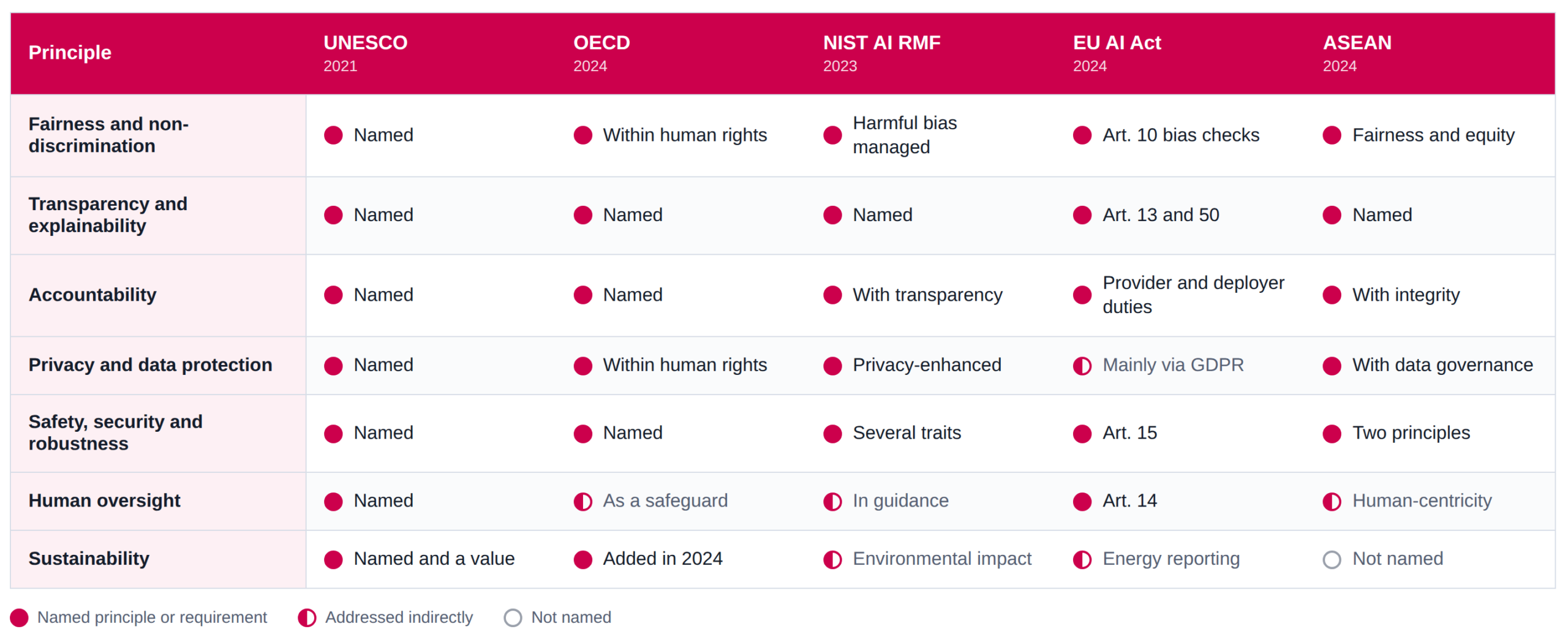
Principle crosswalk
The same study maps the principles to nine technical components. MLOps is vendor neutral: each component can be built from open-source tools or bought as part of a cloud platform. The tools below are examples cited in the research, not recommendations.
Fairness and non-discrimination
AI systems should not produce unjustified differences in outcomes between groups, especially groups protected by law. Bias can enter through unrepresentative training data, proxy variables such as postcode, or the choice of what the model is asked to predict.
Ask. Have we measured performance separately for each group the system affects?
Mapping is DASCIN’s interpretation of the published texts. Frameworks group ideas differently, so a “named” mark means the idea appears as an explicit principle, characteristic or legal requirement.
AI ethics, responsible AI and AI governance
These terms are often used interchangeably, but they describe different layers of the same effort. Ethics sets the direction, governance builds the machinery, and law sets the minimum.
| Term | Main question | Typical outputs |
|---|---|---|
| AI ethics | What is right and wrong for AI, and why? | Values, principles, ethical impact assessments, codes of conduct |
| Responsible AI | How do we build and use AI in line with those principles? | Design practices, bias testing, model documentation, review boards |
| AI governance | Who decides, who is accountable, and how is it checked? | Policies, roles, AI inventories, risk registers, ISO/IEC 42001 management systems |
| AI regulation | What does the law require? | Legal obligations, conformity assessments, penalties (for example the EU AI Act) |
| AI safety | How do we prevent AI from causing serious or catastrophic harm? | Evaluations, red teaming, alignment research, incident response |
Legal compliance is necessary but not sufficient. Much of what is ethically questionable in AI is still legal in many jurisdictions, and laws often lag behind technology by years. Ethics fills that gap.
When AI ethics fails: four well-documented cases
The following cases are cited throughout the AI ethics literature because each one exposed a different kind of failure.
Tensions and trade-offs
Applying AI ethics is rarely a matter of following a checklist, because principles can pull in opposite directions. Stanford’s 2026 AI Index notes recent studies in which training techniques that improved one responsible AI dimension consistently degraded others. Recognizing these tensions openly is part of ethical practice.
Accuracy
vs
Explainability
The most accurate models are often the hardest to explain. In high-stakes decisions, a slightly less accurate but interpretable model may be the more ethical choice.
Fairness
vs
Fairness
Equal error rates across groups and equally calibrated scores cannot both be achieved when base rates differ, as Kleinberg et al. and Chouldechova showed in 2016 and 2017.
Privacy
vs
Bias testing
Checking for discrimination often requires sensitive data such as ethnicity, which privacy rules restrict. Organizations need lawful, minimal ways to test.
Transparency
vs
Security
Disclosing exactly how a system works helps accountability, but can also help bad actors game or attack it.
Innovation
vs
Precaution
Moving fast can deliver benefits sooner, while caution prevents harm. Proportionality, matching controls to the level of risk, is how most frameworks resolve this.
AI ethics and generative AI
Generative AI, including large language models and image generators, has not replaced the classic questions of AI ethics, but it has added new ones and made old ones more urgent.
How to put AI ethics into practice
Principles only matter if they change decisions. These steps draw on the UNESCO Recommendation, the NIST AI RMF and ISO/IEC 42001, and work for organizations of any size.
- 1
Agree on your principles
Adopt a short set of principles based on a recognized framework rather than writing your own from scratch. Get executive sign-off so they carry weight.
- 2
Build an AI inventory
List every AI system you build, buy or use, including AI features inside third-party software. You cannot govern what you cannot see.
- 3
Classify by risk
Assess each system’s potential impact on people. Use the EU AI Act categories where they apply, and focus most effort on high-impact uses such as hiring, credit and health.
- 4
Assess impact before deployment
Run an ethical or fundamental rights impact assessment that covers fairness, privacy, safety and explainability, and involve people who will be affected.
- 5
Assign accountability
Name an owner for each system and set up a cross-functional review group with legal, technical, business and ethics expertise.
- 6
Keep humans in the loop
Define when people review, override or stop an AI decision, and give affected individuals a way to ask for an explanation or appeal.
- 7
Monitor, report and improve
Track performance by subgroup, log incidents and near misses, and review systems regularly. Ethics is a continuous process, not a one-time approval.
AI literacy
Every framework above stresses education. UNESCO lists awareness and literacy as a core principle, and the EU AI Act asks providers and deployers to support AI literacy among staff who work with AI systems. Shared vocabulary is what makes ethical review possible.
Common challenges
References
- UNESCO (2021). Recommendation on the Ethics of Artificial Intelligence. Adopted November 23, 2021, published 2022.
- OECD (2024). OECD updates AI Principles to stay abreast of rapid technological developments (May 3, 2024). See also OECD AI Principles.
- Regulation (EU) 2024/1689 (Artificial Intelligence Act), as amended by Regulation (EU) 2026/1744 (Digital Omnibus on AI), in force July 27, 2026.
- NIST (2023). Artificial Intelligence Risk Management Framework (AI RMF 1.0).
- ISO/IEC 42001:2023, Information technology: Artificial intelligence: Management system.
- ASEAN (2024). ASEAN Guide on AI Governance and Ethics. ASEAN Secretariat, February 2024.
- Stanford HAI (2026). The 2026 AI Index Report, Chapter 3: Responsible AI.
- Jobin, A., Ienca, M. and Vayena, E. (2019). The global landscape of AI ethics guidelines. Nature Machine Intelligence, 1, 389 to 399.
- Floridi, L. and Cowls, J. (2019). A Unified Framework of Five Principles for AI in Society. Harvard Data Science Review, 1(1).
- Buolamwini, J. and Gebru, T. (2018). Gender Shades: Intersectional Accuracy Disparities in Commercial Gender Classification. Proceedings of Machine Learning Research, 81, 77 to 91.
- Angwin, J., Larson, J., Mattu, S. and Kirchner, L. (2016). Machine Bias. ProPublica, May 23, 2016.
- Dastin, J. (2018). Amazon scraps secret AI recruiting tool that showed bias against women. Reuters, October 10, 2018.
- Amnesty International (2021). Xenophobic Machines: Discrimination through unregulated use of algorithms in the Dutch childcare benefits scandal.
- Kleinberg, J., Mullainathan, S. and Raghavan, M. (2016). Inherent Trade-Offs in the Fair Determination of Risk Scores. arXiv:1609.05807.
- Chouldechova, A. (2017). Fair prediction with disparate impact: A study of bias in recidivism prediction instruments. Big Data, 5(2), 153 to 163.
This entry is for general information and is not legal advice. Regulatory details reflect published sources as of October 2026.
Knowledge - Certification - Community