
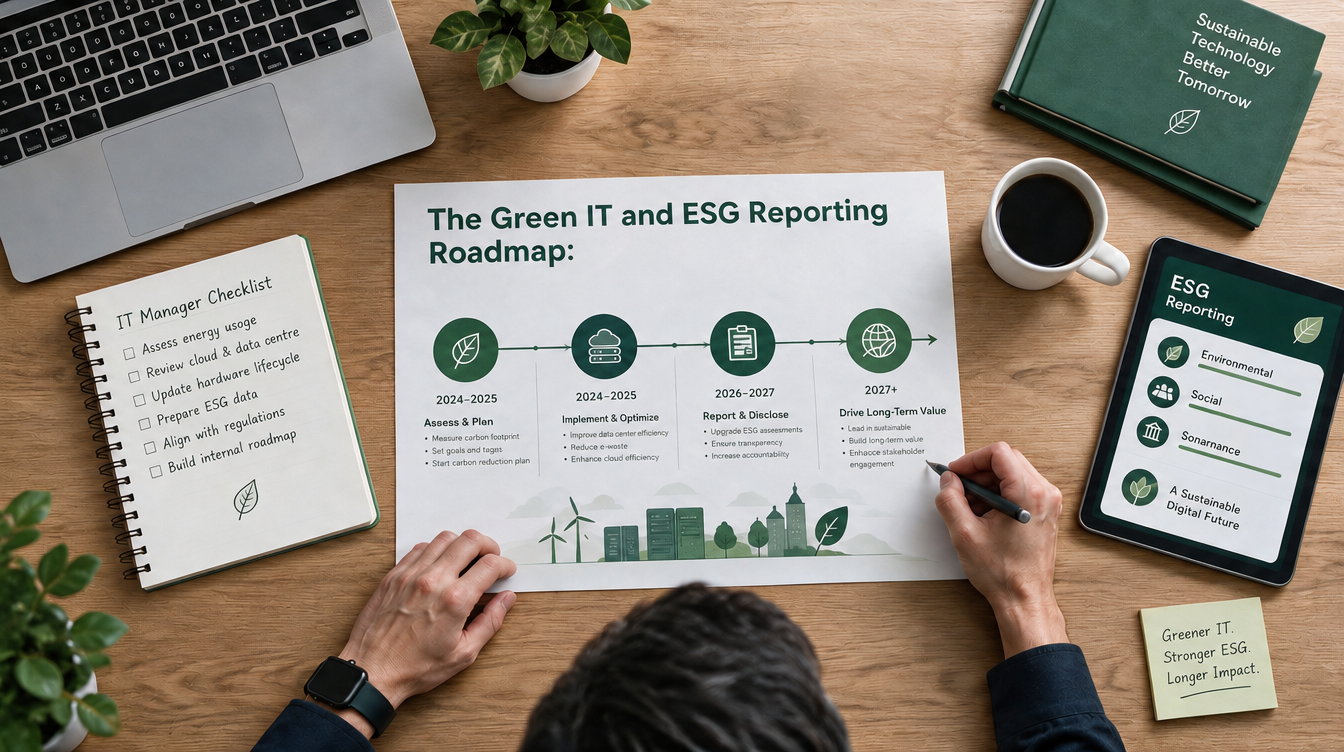
ESG reporting is changing the role of IT. Discover how technology leaders can prepare their infrastructure, emissions data, governance processes and reporting controls for the next phase of sustainability disclosure.
The key message for IT managers
Sustainability reporting needs reliable data, and reliable data needs well-managed technology. Preparing for 2027 means understanding your IT footprint, measuring relevant energy and emissions data, strengthening data governance and improving infrastructure efficiency.
Why ESG reporting is becoming an IT responsibility
ESG reporting is no longer simply a communications exercise or a document prepared by a sustainability department. It increasingly relies on accurate, consistent and traceable information from across an organisation.
Consider the information needed to understand an organisation’s environmental performance: electricity consumption across offices and data centres, energy efficiency of IT infrastructure, greenhouse gas emissions, electronic waste, cloud services, technology suppliers and hardware lifecycles.
Much of this information is generated, stored or managed through technology systems. IT managers therefore have an important role in ensuring the organisation can access reliable information when it needs to report.
This involves working closely with sustainability, finance, procurement, operations, risk management and senior leadership teams. IT is not expected to own every ESG metric, but it can enable the systems, data quality and controls that support credible reporting.
Understand the reporting landscape before 2027
There is no single ESG reporting deadline that applies to every organisation worldwide. Requirements depend on factors such as company size, location, listing status, industry and regulatory scope. However, several frameworks and developments are important for IT managers to understand.
Malaysia: National Sustainability Reporting Framework
Malaysia’s National Sustainability Reporting Framework (NSRF) uses the IFRS Sustainability Disclosure Standards as its baseline, specifically IFRS S1 and IFRS S2. Its published implementation roadmap introduces requirements in phases:
- Group 1: Main Market listed issuers with market capitalisation of RM2 billion or above, from financial years beginning in 2025.
- Group 2: Other Main Market listed issuers, from financial years beginning in 2026.
- Group 3: ACE Market listed issuers and large non-listed companies, from financial years beginning in 2027.
The framework takes a climate-first approach, with organisations building their reporting capabilities over time. Malaysia’s sustainability assurance timeline has also evolved. The Advisory Committee on Sustainability Reporting announced a deferral of mandatory reasonable assurance for Scope 1 and Scope 2 greenhouse gas emissions disclosures, with Group 1 requirements moving to 2028 and Group 2 and Group 3 following in 2029 and 2030 respectively. Organisations should verify the latest implementation guidance before relying on a particular date.
International Financial Reporting Standards: IFRS S1 and IFRS S2
The International Sustainability Standards Board (ISSB) developed IFRS S1 and IFRS S2 to provide a global baseline for sustainability-related financial disclosures. IFRS S1 addresses sustainability-related risks and opportunities that could reasonably be expected to affect an organisation’s prospects. IFRS S2 focuses specifically on climate-related risks and opportunities.
Both standards emphasise four areas: governance, strategy, risk management, and metrics and targets. IT managers can support these areas by providing reliable operational data, maintaining reporting systems, documenting processes and helping establish appropriate controls.
European Union: CSRD and ESRS
The Corporate Sustainability Reporting Directive (CSRD) and European Sustainability Reporting Standards (ESRS) establish sustainability reporting requirements for organisations within their scope. The European reporting landscape has been evolving, so organisations with EU reporting obligations should check the latest applicable rules and implementation dates.
Why this matters for IT managers
Even when an organisation is not directly subject to a reporting requirement, it may be asked to provide information because it belongs to the supply chain of a company that is. IT managers should understand which frameworks are relevant and what information customers, regulators, investors or business partners may request.
Important:
2027 is a significant preparation milestone, not a universal ESG reporting deadline. Confirm the requirements that apply to your organisation and reporting period.
Seven things every IT manager should prepare before 2027
Preparation should start with a clear view of the technology environment and the information it can provide. These seven areas offer a practical starting point.
Understand the emissions categories
Scope 1: Direct emissions from sources owned or controlled by the organisation.
Scope 2: Indirect emissions from the generation of purchased electricity, steam, heating and cooling.
Scope 3: Other indirect emissions across the organisation’s value chain, including relevant purchased goods and services, business travel, transportation and disposal of products.
For IT, Scope 3 can be particularly relevant. Hardware manufacturing, purchased cloud services, equipment transportation and electronic waste may contribute to value-chain emissions. The GHG Protocol provides recognised standards and guidance for measuring corporate greenhouse gas emissions.
A practical IT manager roadmap: now to 2027
Preparation does not need to happen all at once. A phased approach can help organisations build capability without creating unnecessary complexity.
Assess
Map requirements, IT assets and sustainability data gaps.
Measure
Establish energy and emissions baselines.
Govern
Assign owners, methods, validation and evidence controls.
Optimise
Improve infrastructure, suppliers and hardware lifecycle practices.
Report
Support reporting, review controls and prepare for verification.
Adapt the roadmap to your organisation’s reporting obligations, available resources and level of maturity.
DASCIN insight
The role of Green IT in ESG readiness
Green IT is not limited to reducing electricity consumption or replacing old computers. It is a broader approach to managing technology in a way that considers environmental impact throughout the IT lifecycle: how technology is acquired, designed, implemented, operated and eventually retired.
Reducing unnecessary infrastructure capacity, extending hardware lifecycles, improving data centre efficiency, reviewing cloud workloads and applying sustainability criteria to procurement can translate organisational sustainability objectives into practical technology decisions.
Why IT managers need new skills for ESG reporting
The changing reporting landscape creates new expectations for technology professionals. IT managers do not need to become sustainability accountants or regulatory specialists, but they increasingly need to understand how technology, data and environmental performance connect.
- Green IT principles and sustainable technology practices.
- Data governance and data quality management.
- Understanding greenhouse gas emissions categories.
- Sustainability data collection and reporting.
- Supplier and technology lifecycle management.
- Risk management and internal controls.
- Collaboration with sustainability and finance teams.
These capabilities help IT managers contribute more effectively to organisational sustainability objectives and support teams responsible for reporting.
Conclusion
Make 2027 a milestone, not a starting point
ESG and sustainability reporting are changing how organisations collect, manage and communicate information about their environmental and operational performance.
For IT managers, preparation starts with understanding the technology footprint, measuring relevant energy and emissions data, strengthening data governance and improving the efficiency of IT infrastructure.
Organisations that begin building these capabilities early will be better positioned to respond to reporting requirements, stakeholder requests and future sustainability expectations.
The key takeaway is simple: sustainability reporting needs reliable data, and reliable data needs well-managed technology. IT managers have an important role to play in making that possible.
Sources and Further Reading
This article draws on official standards, regulatory publications and technical guidance. Check the latest versions before making compliance decisions.
- Securities Commission Malaysia: National Sustainability Reporting Framework
- Securities Commission Malaysia: official announcements and implementation updates
- IFRS Foundation: IFRS S1 General Requirements for Disclosure of Sustainability-related Financial Information
- IFRS Foundation: IFRS S2 Climate-related Disclosures
- GHG Protocol: Standards and Guidance
- International Energy Agency: Energy and AI
- European Commission: Corporate Sustainability Reporting
- Global Reporting Initiative: GRI Standards

