The New Green IT Implementation Guide Is Here
The Data Science Institute (DASCIN) has published its most comprehensive practitioner resource to date: Implementing Green IT, a 208-page guide authored by DASCIN President Jan-Willem Middelburg. This article walks through what it covers, why Green IT implementation has become urgent, and exactly how organizations can begin putting it into practice.

Why Green IT Implementation Can No Longer Wait
Let’s start with a number that should concentrate the mind: the IT sector is responsible for an estimated four percent of global greenhouse gas emissions – comparable to the entire aviation industry, and growing.
Data centers consume approximately 980 million cubic meters of water annually for cooling. E-waste is the fastest-growing waste stream on the planet. And yet the vast majority of organizations have no formal Green IT strategy, no reliable measurement of their IT-related carbon footprint, and no structured plan for improving it.
This is the gap that structured Green IT implementation is designed to close. Not through vague sustainability commitments, but through the kind of rigorous, component-level planning and measurement that makes environmental improvement genuinely achievable – and genuinely demonstrable.
The question facing IT leaders, sustainability professionals, and enterprise decision-makers in 2026 is no longer whether to take Green IT seriously. Regulatory forces, ESG investor expectations, customer procurement criteria, and the plain mathematics of energy cost have settled that question. The question is: how do you actually implement it, systematically and at scale?
That is precisely what the new DASCIN guide – Implementing Green IT: A Practitioner Guide – is designed to answer.
What Is Green IT Implementation?
Before exploring how to do it, it is worth being precise about what Green IT implementation actually means – because the term is used loosely, and loose usage leads to loose practice.
Green IT implementation is the structured process of reducing the environmental impact of an organization’s information technology operations across their full lifecycle. It is not:
- Installing energy-efficient lightbulbs in the server room
- Publishing a commitment to reach net zero “by 2050” without a plan
- Buying carbon offsets as a substitute for emissions reduction
- Completing a one-time audit and filing the results
Done properly, Green IT implementation is a continuous, data-driven, cross-functional programme that spans the physical devices an organization uses, the software running on them, the processes that shape how they are used, the practices of the people operating them, and the data storage infrastructure underpinning it all.
The DASCIN Green IT Framework – the intellectual foundation on which the new guide is built – organizes this work around seven components: Green IT Strategy, Hardware, Software, Processes, Practices, Data Storage, and the enabling disciplines of Measurement and Reporting, and Continual Improvement. Each component of the Green IT Framework represents a distinct domain of environmental impact and a distinct domain of management action.
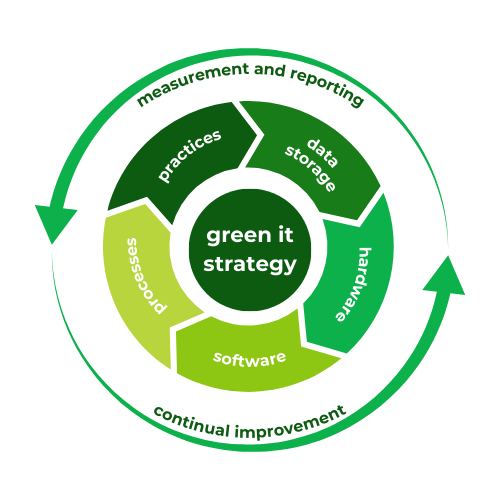
The Seven Components: A Framework for Systematic Action
1. Green IT Strategy
Strategy is what transforms individual sustainability initiatives into organizational change at scale. Without it, hardware teams, software teams, facilities teams, and procurement teams each pursue their own environmental objectives – disconnected, under-resourced, and unable to account for the interactions between them.
Research cited in the new guide finds that only 6% of organizations currently have a highly mature Green IT strategy with clear goals and timelines. This is both a sobering finding and a significant opportunity. Organizations willing to invest in building a genuine strategy are positioning themselves at the leading edge of a rapidly evolving field – and ahead of the compliance curve that regulation is now steadily tightening.
A properly constructed Green IT strategy does four things that informal good intentions cannot: it creates shared goals across functions, allocates resources deliberately, establishes clear accountability, and provides a basis for credible reporting and measurement. The new guide dedicates an entire chapter to building this strategy from first principles, including a best-practice nine-element structure and common pitfalls to avoid.
2. Hardware
Hardware is the component with the most visible environmental impact – and, for most organizations, the largest embedded Scope 3 footprint. A finding that surprises many practitioners: the manufacturing phase of a digital device accounts for approximately 47% of its total lifetime emissions, significantly more than the operational phase. This means that procurement decisions carry an environmental weight that is not always recognized by organizations focused primarily on operational energy efficiency.
The practical implication is significant. For a laptop with a lifecycle carbon footprint of approximately 350 kgCO2e, extending its useful life from three years to five years reduces the annualized lifecycle carbon by 40% – without any change to the device’s energy efficiency. The most impactful hardware sustainability decision an organization can make is often not what to buy, but whether to buy at all, and how long to keep what it already has.
Effective hardware Green IT implementation covers three areas: energy-efficient procurement (ENERGY STAR certification as a mandatory criterion, not a preference), product lifecycle extension through maintenance and repair-first policies, and responsible end-of-life management through certified IT Asset Disposal (ITAD) partnerships.
3. Software
Software is the component most consistently overlooked in sustainability frameworks – and one of the most powerful levers for reducing environmental impact. Software does not emit greenhouse gases directly, but it determines how hard the underlying hardware must work, and therefore has a direct and substantial effect on energy consumption.
The central insight is stark: a server running at 20% average utilization is consuming 80% of its energy on idle overhead. Across the scale at which modern digital organizations operate, the cumulative energy impact of software inefficiency is enormous. The guide provides a worked example from a media organization whose virtual machine estate was running at 17% average utilization – meaning 83% of provisioned server capacity was idle at any time. A targeted consolidation programme over eight months raised utilization to 58%, reduced idle energy overhead by 62%, and generated annual energy cost savings of approximately £28,000 – alongside the elimination of over 52 tonnes of CO2 equivalent per year.
Key software implementation priorities include: server and cloud resource utilization management, workload consolidation and virtualization, scheduling computationally intensive tasks to align with periods of lower grid carbon intensity, and the adoption of green coding practices that reduce the energy intensity of applications.
4. Processes
Processes refers to the organizational workflows and routines that shape how technology is used – and many of the most impactful process improvements require policy decisions rather than capital investment.
One data point from the guide stands out: remote workers can have a carbon footprint up to 54% lower than equivalent on-site workers. The commuting and office energy implications of work location policies are among the largest process-level levers available to IT-intensive organizations – and in many cases, the policies enabling them are already in place for reasons entirely unrelated to sustainability.
Other key process domains include: paperless office initiatives, energy source management and the transition to renewable energy, and carbon-aware computing – the practice of scheduling deferrable workloads (batch processing, backups, model training) to run during periods when grid carbon intensity is lower. A consulting organization case study in the guide describes how modelling the commuting emissions impact of a hybrid working policy predicted an annual reduction of 340 tCO2e – subsequently confirmed by post-implementation measurement at 318 tCO2e. The measurement framework made that result visible and the business case achievable.
5. Practices
Practices covers the behavioral, cultural, and design dimensions of Green IT – the patterns of individual and organizational action that formal processes and policies alone cannot fully determine. It is the component most dependent on sustained leadership commitment, and the one where the gap between intent and reality is most likely to be significant.
Key practice areas include: employee awareness and Green IT training programmes, eco-friendly design standards embedded into software and hardware configuration decisions, appropriate use of carbon offset programmes as a complement to (not a substitute for) emissions reduction, and technical practices such as power management configuration across the device fleet.
The guide provides a formula for quantifying the carbon wasted through poor device power management across a large workstation estate – a calculation that routinely reveals this to be a surprisingly significant source of avoidable emissions, addressable at near-zero cost through centralized policy deployment via endpoint management tools.
6. Data Storage
Data Storage has grown substantially as an area of environmental concern as the volume of data that organizations generate, process, and retain has increased exponentially. Data centers currently account for approximately 2% of global energy demand and consume an estimated 980 million cubic meters of water annually for cooling.
Sustainable data storage implementation focuses on four priorities: choosing cloud providers with genuine renewable energy commitments, disciplined data lifecycle management to prevent the accumulation of redundant, obsolete, and trivial (ROT) data, data compression and deduplication to reduce storage volume requirements, and monitoring Power Usage Effectiveness (PUE) as the primary metric of data center energy efficiency.
PUE illustrates the scale of the opportunity clearly. An organization whose data center has a PUE of 1.8 is consuming 1.8 kWh of total facility energy for every 1 kWh used by IT equipment – meaning 44% of total energy spend is overhead rather than productive computing. A financial services organization case study in the guide discovered its data center had a PUE of 2.3, accounting for over 60% of total IT-related carbon emissions. This single finding redirected the organization’s entire Green IT priority list.
7. Measurement, Reporting, and Continual Improvement
The final two components – Measurement and Reporting, and Continual Improvement – function as the enabling disciplines that make action in all the other areas purposeful, trackable, and sustainable over time.
Measurement without action is a reporting exercise. Action without measurement is guesswork. The guide’s measurement framework integrates established tools – the Greenhouse Gas Protocol, PUE, the GRI Standards, Life Cycle Assessment, and the ISO/IEC 30134 series – into a coherent component-by-component model that produces a composite Green IT Impact Score (GIIS): a single, normalized index that aggregates performance across all five operational components and enables organizations to communicate progress to non-specialist stakeholders including boards, investors, and employees.
How to Start: A Structured Approach to Green IT Implementation
Understanding the framework is the beginning. Actually implementing it requires a sequenced approach. The new guide provides this in detail, but the core logic can be summarized in four stages.
Stage 1: Conduct a Green IT Readiness Assessment
Before any implementation work begins, organizations need a clear and honest picture of where they currently stand across each component. The readiness assessment evaluates the organization’s current maturity on a five-point scale – from “Unaware” to “Optimizing” – for each of the seven framework components.
This is not primarily a technical audit. It is an organizational assessment that examines governance structures, policies, data availability, existing initiatives, and cultural readiness alongside infrastructure and technology choices. The assessment team should be cross-functional, including representation from IT leadership, facilities and operations, procurement, finance, and human resources.
The output is a component-by-component maturity profile that identifies the areas of greatest environmental impact, the greatest potential for improvement, and the quick wins that can be implemented rapidly at low cost.
Stage 2: Map Your IT Environmental Footprint
Alongside the readiness assessment, organizations should develop an initial map of their IT environmental footprint – a qualitative-to-quantitative exercise that identifies the primary sources of environmental impact and estimates their relative scale.
The five dimensions to examine: energy consumption (data centers, server rooms, workstations, networking equipment), carbon emissions across Scopes 1, 2, and 3, e-waste volumes and disposal channels, data storage volumes and growth rates, and supply chain sustainability credentials. The purpose of this mapping is directional: to identify where the largest impacts lie and therefore where the greatest potential for improvement exists. Precision is not required at this stage. A good baseline established with incomplete data and improved over time is far more useful than a perfect baseline deferred indefinitely.
Stage 3: Build the Business Case
Green IT implementation at organizational scale requires executive sponsorship. Securing it requires a clear, credible business case that connects sustainability investment to outcomes that decision-makers are already accountable for.
The guide’s approach to business case construction is instructive. A global logistics organization case study describes how an initial Green IT proposal framed around environmental responsibility gained limited traction with the executive team. When the sustainability team reframed the same proposal around three concrete financial metrics – a projected annual saving of €4.2 million in energy costs, a 30% reduction in hardware procurement expenditure through lifecycle extension, and a risk mitigation value associated with EU carbon reporting requirements – the proposal was approved within a single board cycle.
The environmental case was identical in both proposals. The difference was in the language used to express it.
Different leaders respond to different aspects of the business case. The CFO focuses on cost savings and payback periods. The CTO focuses on operational efficiency and modernization. The CEO and board focus on strategic positioning and regulatory compliance. The CPO focuses on talent attraction and employee engagement. The most effective business cases address all four simultaneously.
Stage 4: Implement, Measure, and Improve
With strategy defined, baseline established, and leadership commitment secured, implementation follows the roadmap developed from the readiness assessment and footprint mapping – sequencing quick wins to build momentum and credibility while laying the groundwork for the structural changes that deliver the greatest long-term environmental improvement.
The guide is explicit that implementation is not a project with a completion date. It is the beginning of an ongoing management practice. Technologies evolve, regulations change, organizational contexts shift. Green IT implementation that treats its initial deployment as a destination – rather than a direction of travel – will find its practices outdated and its impact diminishing within a few years.
The Regulatory Imperative: Why 2026 Is the Year to Act
The external environment for Green IT is changing at a pace that makes delay increasingly costly. Several regulatory developments have direct implications for IT operations.
In the European Union, the Corporate Sustainability Reporting Directive (CSRD) is extending mandatory sustainability reporting requirements to a growing proportion of companies, including detailed requirements for reporting on energy consumption, greenhouse gas emissions, and waste. In the UK, Streamlined Energy and Carbon Reporting (SECR) already requires large companies to disclose their energy use and carbon emissions. The SEC in the US has proposed rules requiring climate-related risk and emissions disclosures from public companies.
IT is frequently one of the largest contributors to an organization’s total energy consumption and carbon footprint. An organization that cannot produce reliable, component-level data on the environmental impact of its IT operations will struggle to meet these requirements – and will find itself investing in reactive compliance work that a proactive Green IT strategy would have made unnecessary.
The organizations that build genuine Green IT implementation capability now are not just getting ahead of regulation. They are building a competitive advantage that will compound over time: in energy cost reduction, in talent attraction, in customer procurement qualification, and in investor ESG evaluation.
Why frameworks Matter: the DASCIN Difference
There is no shortage of sustainability frameworks, certification standards, and best practice guides in circulation. What makes the DASCIN Green IT Framework distinctive is its specificity to the IT domain combined with its coverage of the full organizational scope.
Most existing sustainability frameworks treat IT as one input among many. The DASCIN Green IT Framework was designed from the ground up to address the unique challenges and opportunities of IT operations – spanning the full lifecycle of hardware, software, data, and organizational practice, with a measurement model calibrated to the specific metrics and data sources available to IT practitioners.
The new implementation guide extends this by translating the framework’s architecture into the language of operational practice: the specific decisions that need to be made, the specific obstacles that will be encountered, and the specific strategies that evidence and experience suggest are most likely to overcome them.
For practitioners who have found other frameworks too abstract to act on, the guide provides the level of practical specificity that makes the difference between intent and delivery.
Start Your Green IT Implementation Journey Today
The path to sustainable IT is not a short one. But it is a well-lit one – and the organizations that begin now, with a structured, evidence-based approach, will be significantly ahead of those that wait for the regulatory deadline or the next energy cost shock to force the issue.
Whether you are just beginning to map your organization’s IT environmental footprint, building the business case for executive sponsorship, or leading a mature programme that needs a more rigorous measurement framework, the new DASCIN Green IT Implementation Guide has the tools you need.
Ready to formalize your Green IT expertise? Explore the DASCIN Green IT Foundation credential and begin your certification journey at dascin.org.
Knowledge - Certification - Community